Home
Class 12
CHEMISTRY
An ester 'A' (C(4)H(8)O(2)) on treatment...

An ester 'A' `(C_(4)H_(8)O_(2))` on treatment with excess methyl magnesium chloride followed on acidification gives an alcohol 'B' as the sole organic product. Alochol 'B' as the organic product. Alcohol 'B' on oxidation with NaOCl followed by acidification gives acetic acid. Deduce structure of A and B. Show the reactions involved.

Text Solution

Verified by Experts
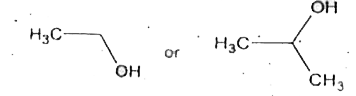
(i) Since alcohol (B) on oxidation with NaOCl haloform reaction ) followed by acidification gives acetic acid thus it can be either ethyl alcohol or 2-propanol.

(ii) Since alcohol (B) is obtained by addtion of excess of `CH_(3)MgCl`, on ester (A), therefore the alcohol both the methyl group because esters and two molecules of the Grignard reagent that is its (CH - OH) part has come form acid part of ester . Thus (A) must be fomic ester .
(iv) Since molecular formula of ester (A) is `C_(4)H_(4)O_(2)`, therefore alkyl group of ester must contain three carbon atoms either n - propyl group or isopropyl group.
(v) Further , since 2 - propanol (B) is the sole organic product obtained when two molecules of `(CH_(3))_(3)`MgCl are added to ester (A). Therefore , the alkyl group of ester (A) must be isopropyl group.
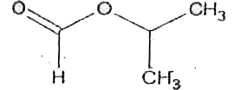
Thus , ester is isopropyl formate .
Promotional Banner

Similar Questions

Explore conceptually related problems

Assign the structure of (B), the principal organic product of the following reaction:

How many isomer of C_(4)H_(8)O when reacts with CH_(3)MgBr followed by acidification to give 2^(@) alcohol (only consider carbonyl isomers) ? (including stereoisomer)

Give the majore and minor products of the following reactions. a. b.

A compounds X is fromed by the reaction of a carboxylic acid C_(2)H_(4)O_(2) and an alcohol in the presence of a few drops of H_(2)SO_(4) . The alcohol on oxidation with alkalne KMnO_(4) followed by acidification gives the same carboxylic as used in this reaction. Give the names and structures of (a) carboxylic acid, (b) alcohol and (c ) the compound X. Also write the reaction.

An optically active alcohol A (C_(6)H_(10)O) absorbs 2 mol of hydrogen per mole of A upon catalytic hydrogenation and gives a product B. The compound B is resistant to oxidation by CrO_(3) and does not show any optical activity Deduce the structures of A and B.

A compound [A] has the formula C_(4)H_(8)O_(2) . When reacted with a Grignard reagent, CH_(3)MgBr , it takes up two molecules of it and upon acidification gives an alcohol [B]. The alcohol on reacting with Lucas reagent gives white coludiness on standing for sometime. When the alochol is oxidised, a compound [C] is produced with a pleasant smell. It neither reacts with Tollen's reagent, nor with Fehling's reagent. The alcohol [B] is

A compound [A] has the formula C_(4)H_(8)O_(2) . When reacted with a Grignard reagent, CH_(3)MgBr , it takes up two molecules of it and upon acidification gives an alcohol [B]. The alcohol on reacting with Lucas reagent gives white coludiness on standing for sometime. When the alochol is oxidised, a compound [C] is produced with a pleasant smell. It neither reacts with Tollen's reagent, nor with Fehling's reagent. The compound [A] is

A compound [A] has the formula C_(4)H_(8)O_(2) . When reacted with a Grignard reagent, CH_(3)MgBr , it takes up two molecules of it and upon acidification gives an alcohol [B]. The alcohol on reacting with Lucas reagent gives white coludiness on standing for sometime. When the alochol is oxidised, a compound [C] is produced with a pleasant smell. It neither reacts with Tollen's reagent, nor with Fehling's reagent. The compound [A] is