Home
Class 12
PHYSICS
A uniform bar of square cross-section is...

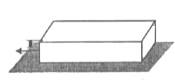
A uniform bar of square cross-section is lying along a frictionless horizontal surface. A horizontal force is applied to pull it from one of its ends then

A

The bar I sunder same stress throughout its length

B

The bar is not under any stress because forces has been applied only at one end

C

The bar simply moves without any stress in it

D

The stress developed reduces to zero at the end of the bar where no force is applied

Text Solution

Verified by Experts

The correct Answer is:

D
Promotional Banner

Similar Questions

Explore conceptually related problems

To keep a particle moving with constant velocity on a frictionless horizontal surface an external force

A uniform solid cylinder of mass m and radius R is placed on a rough horizontal surface. A horizontal constant force F is applied at the top point P of the cylinder so that it start pure rolling. The acceleration of the cylinder is

Uniform solid cylinder of mass m and radius R is placed on a rough horizontal surface. A horizontal constant force is applied at the top point P of the cylinder so that it start pure rolling .In the above question, the frictional force on the cylinder is

A ball is moving on a perfectly smooth horizontal surface. If no force is applied on it, will its speed decrease, increase or remain unchanged ?

End A of the bar AB in figure rests on a frictionless horizontal surface and end B is hinged. A horizontal force vecF of magnitude 120 N is exerted on end A . You can ignore the weight of the bar. What is the net force exerted by the bar on the hinge at B ?

A uniform rod of mass M and length L, area of cross section A is placed on a smooth horizontal surface. Forces acting on the rod are shown in the digram Ratio of elongation in section PQ of rod and section QR of rod is

A uniform sphere is place on a smooth horizontal surface and as horizontal force F is appied on it at a distance h above the surface. The acceleratioin of the centre

A 5 kg rod of square cross section 5 cm on a side and 1m long is pulled along a smooth horizontal surface by a force applied at one end. The rod has a constant acceleration of 2 ms^(-12) . Determine the elongation in the rod. (Young's modulus of the material of the rod is 5 xx 10^(3) N//m^(9) ).

A uniform rod of mass M and length L, area of cross section A is placed on a smooth horizontal surface. Forces acting on the rod are shown in the digram Total elastic potential energy stored in the rod is :

A uniform board of length L is sliding along a smooth (frictionless) horizontal plane as in figure. The board then slides across the boundary with a rough horizontal surface. The coefficient of kinetic friction between the board and the second surface surface is mu_k a. Find the acceleration of the board at the moment its front end has traveled a distance x beyond the boundary. b. The board stops at the moment its back end reaches the boundary, as in figure. Find the initail speed v of the board.
