Home
Class 12
PHYSICS
Let vec( a) (1) and vec( a) (2) are the ...

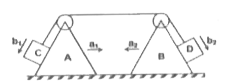
Let `vec( a) _(1)` and `vec( a) _(2)` are the acceleration of wedges A and B. Let `vec(b)_(1)` and `vec(b)_(1)` be the accelerations of C and D relative to wedges A and B respectively. Choose the right relation `:`

A

`vec(a)_(1)-vec(a)_(2) +vec(b)_(1)-vec(b)_(2)=0`

B

`vec(a)_(1)+vec(a)_(2) +vec(b)_(1)+vec(b)_(2)=0`

C

`vec(a)_(1)+vec(a)_(2) -vec(b)_(1)-vec(b)_(2)=0`

D

`vec(a)_(1)+2vec(b)_(2) =2vec(a)_(2)-vec(b)_(1)=0`

Text Solution

Verified by Experts

The correct Answer is:

B
Promotional Banner

Similar Questions

Explore conceptually related problems

Let vec(C )= vec(A)+vec(B) then

Let vec(A), vec(B) and vec(C) , be unit vectors. Suppose that vec(A).vec(B)=vec(A).vec(C)=0 and the angle between vec(B) and vec(C) is pi/6 then

Let vec a , vec b , vec c be three unit vectors such that | vec a+ vec b+ vec c| = 1 and vec a_|_ vec bdot If vec c makes angles alpha,beta with vec a , vec b respectively then cosalpha+cosbeta is equal to (a) 3/2 (b) 1 (c) -1 (d) None of these

Let vectors vec a , vec b , vec c ,a n d vec d be such that ( vec axx vec b)xx( vec cxx vec d)=0. Let P_1a n dP_2 be planes determined by the pair of vectors vec a , vec b ,a n d vec c , vec d , respectively. Then the angle between P_1a n dP_2 is a. 0 b. pi//4 c. pi//3 d. pi//2

Let ABC be a triangle whose circumcentre is at P. If the position vectors of A, B, C and P are vec(a) , vec(b) , vec(c ) and (vec(a) + vec(b) + vec(c ))/(4) respectively, then the position vector of the orthocentre of this triangle is

Let vec(A)D be the angle bisector of angle A" of " Delta ABC such that vec(A)D=alpha vec(A)B+beta vec(A)C, then

Vectors vec a and vec b are non-collinear. Find for what value of n vectors vec c=(n-2) vec a+ vec b and vec d=(2n+1) vec a- vec b are collinear?

If | vec(a) | = | vec( b) | =1 and | vec(a ) xx vec( b)| =1 , then

If vec a\ a n d\ vec b are two vectors such that | vec axx vec b|=3\ a n d\ vec adot vec b=1, find the angle between vec a\ a n d\ vec b .

Let vec(a), vec(b), vec(c) be vectors of length 3, 4, 5 respectively. Let vec(a) be perpendicular to vec(b)+vec(c), vec(b) to vec(c)+vec(a) and vec(c) to vec(a)+vec(b) . Then |vec(a)+vec(b)+vec(c)| is :
