Home
Class 12
PHYSICS
A uniform square plate ABCD has mass M ...

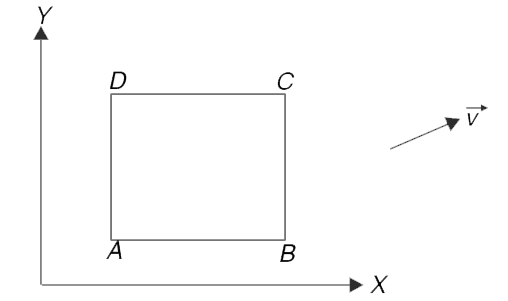
A uniform square plate ABCD has mass M side length `a`. It is sliding on a horizontal smooth surface with a velocity of`vec(v) = v_(0) (4 hat(i) + 2 hat(j))`. There is no rotation. Vertex A of the plate is suddenly fixed by a nail. Calculate the velocity of centre of the plate immediately after this

A

`v_(0) ( 2 hat(i) + 4 hat( j))`

B

`( 3v_(0))/( 4) ( - hat(i)) + ( 3v_(0))/(4) hat(j)`

C

`(3v_(0))/(2) hat(i) - ( 3v_(0))/( 2) hat(j)`

D

`3v_(0)hat(i) - 3v_(0)hat(j)`

Text Solution

Verified by Experts

The correct Answer is:

B
Promotional Banner

Similar Questions

Explore conceptually related problems

A uniform cube of mass m and edge a moves on a horizontal surface along the positive x-axis, with initial velocity v_(0) . Then

A ring of mass m sliding on a smooth surface with velocity v_(0) enters rough surface with coefficient of kinetic friction mu_(k) , then

A smooth sphere is moving on a horizontal surface with velocity vector 3hat(i) + hat(j) immediately before it hits a vertical wall. The wall is parallel to the vector hat(j) and the coefficient of restitution between the wall and sphere is (1)/(3) . The velocity vector of the sphere after it hits the wall is :-

A uniform ring of radius R is given a back spin of angular velocity V_(0)//2R and thrown on a horizontal rough surface with velocity of centre to be V_(0) . The velocity of the centre of the ring when it starts pure rolling will be

A portion is fired from origin with velocity vec(v) = v_(0) hat(j)+ v_(0) hat(k) in a uniform magnetic field vec(B) = B_(0) hat(j) . In the subsequent motion of the proton

A conductor AB of length l moves in x y plane with velocity vec(v) = v_(0)(hat(i)-hat(j)) . A magnetic field vec(B) = B_(0) (hat(i) + hat(j)) exists in the region. The induced emf is

A smooth sphere of mass m is moving on a horizontal plane with a velocity (3hati +hat j) . It collides with smooth a vertical wall which is parallel to the vector hatj . If coefficient of restitution e = 1/2 then impulse that acts on the sphere is

Consider an object of mass m moving in free space with velocity given by vec(v) = v_(0) cos omega t hat (i) +v_(0) sin omegat hat (j) . Here v_(0) and omega are constants and t represents time. calculate force acting on object and angle between force and momentum.

A particle leaves the origin with initial velocity vec(v)_(0)=11hat(i)+14 hat(j) m//s . It undergoes a constant acceleration given by vec(a)=-22/5 hat(i)+2/15 hat(j) m//s^(2) . When does the particle cross the y-axis ?

A particle has an initial velocity of 3hat(i) + 4 hat(j) and an acceleration of 0.4 hat(i) + 0.3 hat(j) . Its speed after 10s is :
