Home
Class 12
PHYSICS
A lever PQ, hinged at P, of mass 'm' and...

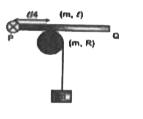
A lever PQ, hinged at P, of mass 'm' and length 'l' lies on the drum ( solid cylinder ) of mass 'm' and radius 'R'.The drum can rotate about the horizontal axis passing through O. The coefficient of friction between the lever and drum is `1//4`. A block of mass 'm' is connected through the string with the drum as shown in the figure. The string does not slip on the drum. Then the acceleration of the block is

A

`g//3`

B

`g//2`

C

`g//4`

D

zero

Text Solution

Verified by Experts

The correct Answer is:

A
Promotional Banner

Similar Questions

Explore conceptually related problems

A uniform disc of radius R and mass M is free to rotate about a fixed horizontal axis perpendicular to its plane and passing through its centre. A string is wrapped over its rim and a block of mass m is attached to the free end of the string. The block is released from rest. If string does not slip on the rim then find the acceleration of the block. Neglect the mass of the string.

Two blocks, each having mass m, are connected with an ideal string through ideal pulleys on a frictionless fixed wedge as shown in the figure. The acceleration of the blocks is

A uniform solid cylinder of mass m and radius 2R rests on a horizontal table. A string attached to it passes over a pulley (disc) of mass m and radius R that is mounted on a fricitonaless axle through its centre . A block of mass m is suspended from the free end of the spring . The string does not slip over the pulley surface and the cylinder rolls without slipping on the table. Acceleration of the block is

Two blocks of same mass 'm' are connected by the cable passing over a pulley of mass 'm' and radius 'R'. There is no slipping between the pulley and the cable. The coefficient of friction between the block 'A' and the horizontal surface is 1//4 . At the moment shown in the figure,the tension in the cable AB is

Blocks of mass M_(1) and M_(2) are connected by a cord which passes over the pulleys P_(1) and P_(2) as shown in the figure. If there is no friction, the acceleration of the block of mass M_(2) will be

A block of mass m is attached at the end of an inextensible string which is wound over a rough pulley of mass M and radius R figure a. Assume the string does not slide over the pulley. Find the acceleration of the block when released.

Match the Moment of inertia of a solid cylinder of mass m, radius R and length l along various axis as shown in figure.

A rod PQ of mass M and length L is hinged at end P . The rod is kept horizontal by a massless string tied to point Q as shown in the figure. When string is cut, the initial angular accleration of the rod is.

A block A of mass 5 sqrt( 3) m rests on a rough horizontal plane relative to which its coefficient of friction is mu A light string attached to this block passes over a light frictionless pulley and another block B of mass m hangs from it. It is observed that the block A just slips when the string makes an angle of 60^(@) with the horizontal . Find the coefficient of static friction between the block A and the plane. If the same force acting through the sting is applied to the block A in the horizontal direction, find the acceleration of the block A.

A cart of mass M has a block of mass m in contact with it as shown in the figure-2.133. The coefficient of friction between the block and the cart is mu . What is the minimum acceleration of the cart so that the block m does not fall ?
