Home
Class 12
PHYSICS
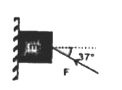
A homogeneous block rests against a vert...

A homogeneous block rests against a vertical wall for which the coefficient of friction is `1//2`. A force 'F' is applied to the block in the direction as shown in figure. Find the maximum magnitude of applied force 'F' such that block remains in rest.

A

mg

B

5mg

C

`mg //5`

D

`mg//2`

Text Solution

Verified by Experts

The correct Answer is:

B
Promotional Banner

Similar Questions

Explore conceptually related problems

A block is placed on a smooth inclined plane as shown . For what value of horizontal force F, the block will remain at rest ?

A force shown in the F-x graph is applied to a 2kg block horizontal as shown in figure. The change in kinetic energy is

A block of mass 2 kg is placed on the floor. The coefficient of static friction is 0.4. A force F of 3 N is applied on the block as shown in figure. The force of friction between the block and the floor is (Take g=10 m s^(-2) )

A block of mass 2 kg is pushed against a rough vertical wall with a force is 40 N. Coefficient of static friction being 0.5. Another horizontal force is 15 N, is applied on the block in a direction parallel to the wall. Will the block move? If yes in which direction? If no, find the frictional force exerted by the wall on the block.

A block of mass 2 kg is pushed against a rough vertical wall with a force of 40N. Coefficient of static friction being 0.5. Another horizontal force of 15 N, is applied on the block in a direction parallel to the wall. Will the block move? If yes in which direction? If no, find the frictional force exerted by the wall on the block.

A cubical box of side L rests on a rough horizontal surface with coefficient of friction p. A horizontal force F is a applied on the block as shown in Fig. 15.4.6. If the coefficient of friction is sufficiently high so that the block does not slide before toppling, the minimum force required to topple the block is

A block of mass m=5kg is resting on a rough horizontal surface for which the coefficient of friction is 0.2 . When a force F=40N is applied, the acceleration of the block will be (g=10m//s^(2)) .

A block of mass 1kg is pushed against a rough vertical wall with a force of 20N , coefficient of static friction being (1)/(4) Another horizontal force of 10N is applied on the block in a direction parallel to the wall. Will the block move? If yes, in which direction ? If no, find the frictional force exerted by the wall on the block. (g = 10m//s^(2))

A particle of mass m rests on a horizontal floor with which it has a coefficient of static friction mu . It is desired to make the body move by applying the minimum possible force F. Find the magnitude of F and the direction in which it has to be applied.

Two blocks A and B are lying on the table as shown in the figure. The coefficient of friciton between block A and block B is mu . The coefficient of friction between block B and ground also mu . An external force F is applied in the direction shown. The maximum value of the force F that can be applied without moving the blocks.
