Home
Class 12
PHYSICS
A spring-block system lies inside the ho...

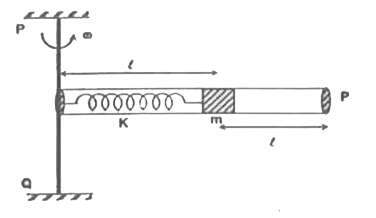
A spring-block system lies inside the horizontal frictionless tube as shown in figure. At t=0, tube starts rotating with uniform angular velocity `'omega'`. Initially spring was in its natural length. If the block collides with the other end of tube and the collision is perfectly elastic, then find the magnitude of block's velocity after the collidon with respect to ground. ( take k` = m omega^(2)` )

A

`sqrt(2) omega l`

B

`sqrt( 5) omega l`

C

`sqrt( 3) omegal`

D

`sqrt( 6) omega l`

Text Solution

Verified by Experts

The correct Answer is:

D
Promotional Banner

Similar Questions

Explore conceptually related problems

A spring block system is placed on a horizontal rough surface as shown in the figure. The block is given velocity when the spring is in natural length. The total distance travelled by the block before if finally comes to rest is 2/k meters. Find the value of k

A spring block system is kept inside the smooth surface of a trolley as shown in figure. At t = 0 trolley is given an acceleration 'a' in the direction shown in figure. Write S - t equation of the block (a) with respect to trolley. (b) with respect to ground.

A spring-block system is resting on a frictionless floor as shown in the figure. The spring constant is 2.0Nm^(-1) and the mass of the block is 2.0 kg. Ignore the mass of the spring. Initially the spring is in an unstretched condition. Another block of mass 1.0 kg moving with a speed of 2.0ms^(-1) collides elastically with the first block. The collision is such that the 2.0 kg block does not hit the wall. The distance, in metres, between the two blocks when the spring returns to its unstretched position for the first time after the collision is

A point mass m collides with a disc of mass m and radius R resting on a rough horizontal surface as shown . Its collision is perfectly elastic. Find angular velocity of the disc after pure rolling starts

A block of mass m is attached to a spring of force constant k whose other end is fixed to a horizontal surface. Initially the spring is in its natural length and the block is released from rest. The average force acting on the surface by the spring till the instant when the block has zero acceleration for the first time is

Two blocks of mass m_(1) and m_(2) (m_(1) lt m_(2)) are connected with an ideal spring on a smooth horizontal surface as shown in figure. At t = 0 m_(1) is at rest and m_(2) is given a velocity v towards right. At this moment, spring is in its natural length. Then choose the correct alternative :

Two blocks of mass m_(1) and m_(2) (m_(1) lt m_(2)) are connected with an ideal spring on a smooth horizontal surface as shown in figure. At t = 0 m_(1) is at rest and m_(2) is given a velocity v towards right. At this moment, spring is in its natural length. Then choose the correct alternative :

Two block A and B of masses m and 2m respectively are connected by a spring of spring cosntant k. The masses are moving to the right with a uniform velocity v_(0) each, the heavier mass leading the lighter one. The spring is of natural length during this motion. Block B collides head on with a thrid block C of mass 2m . at rest, the collision being completely inelastic. The velocity of block B just after collision is -

A block of mass m is pushed against a spring of spring constant k fixed at the end to a wall. The block can side on a frictionless table as shown in figure. The natural length of the spring is L_0 and it is compressed ti half its natural length when the block is relesed. Find teh velocity of the block aa s function of its distance x from the wall .

Three blocks of masses m , m and M are kept on a frictionless floor as shown in the figure .The leftmost block is given velocity v towards the right . All the collision between the blocks are perfectly inelastic . The loss in kinetic energy after all the collision is 5//6th of initial kinetic energy. The ratio of M//m will be
