Home
Class 12
PHYSICS
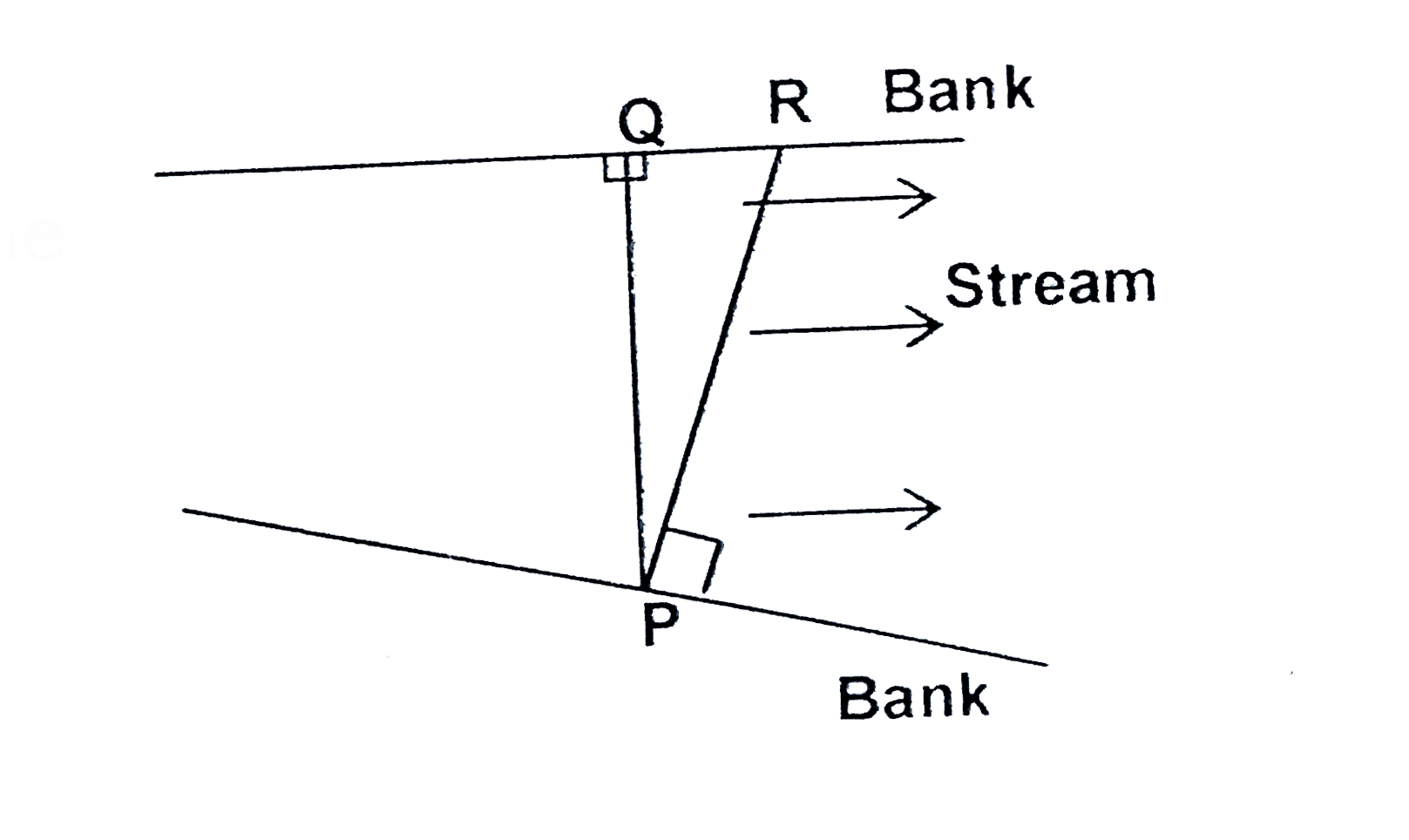
In a lake, stream direction is as shown ...

In a lake, stream direction is as shown in the figure. A man starting from the point P on the bank wants to move to otherside of the bank in minimum time , so which direction he must travel ?


A. along PQ
B. along PR
C. In a direction in-between PQ and PR
D. in all cases he would reach at the same time

A

along PQ

B

along PR

C

In a direction in-between PQ and PR

D

in all cases he would reach at the same time

Text Solution

Verified by Experts

The correct Answer is:

A
Promotional Banner

Similar Questions

Explore conceptually related problems

In a lake, stream direction is as shown in the figure. A man starting from the point P on the bank wants to move to the otherside of the bank in shortest time .Then direction in which he should swim

Velocity of the boat with respect to river is 10 m/s. From point A it is steered in the direction shown to reach point C. Find the time of the trip and distance between B and C

A river is flowing due east with a speed 3 m//s (Fig. 2 (EP) .31 ). . (a) If swimmer starts swimming due north, what will be his resultant velocity (magnitude and direction) ? (b) If he wants to start from point (A) on South bank and reach opposite point (B) on North bank, (i) Which direction should he swim? (ii) What will be his resultant speed ? (c ) From two differenrent casses as mentioned in (a) and 9b) above, in which casse will he reach opposite bank in shorter time ?

A man wants to reach point B on the opposite bank of a river flowing at a speed as shown in figure. What minimum speed relative to water should the man have so that he can reach point B? In which direction should he swim?

A man starts walking in south direction from point P (as shown in figure) & reaches point Q(PQ = 4m) , then the moves towards east direction & reaches at point R(QR = 3m) . Now he moves towards north direction & reaches at points S(RS = 10m) & finally he moves towards east direction & reaches at point T(ST = Xm) . On the basis of above information, answer the following questions : Length X is-

A man starts walking in south direction from point P (as shown in figure) & reaches point Q(PQ = 4m) , then the moves towards east direction & reaches at point R(QR = 3m) . Now he moves towards north direction & reaches at points S(RS = 10m) & finally he moves towards east direction & reaches at point T(ST = Xm) . On the basis of above information, answer the following questions : Length QT is-

A man starts walking in south direction from point P (as shown in figure) & reaches point Q(PQ = 4m) , then the moves towards east direction & reaches at point R(QR = 3m) . Now he moves towards north direction & reaches at points S(RS = 10m) & finally he moves towards east direction & reaches at point T(ST = Xm) . On the basis of above information, answer the following questions : tan theta is-

Velocity of a boat relative to river current and river current velocity are equal in magnitude. Starting from point A on the southern bank, the boatman wants to reach a point B on the nothern bank in north - east from A . In which direction he has to steer the boat?

A man wishes to swim across a river 40 m wide flowing with a speed of 3m/s. such that he reaches the point just infront on the other bank in time not greater than 10s. The angle made by the direction he swims and river flow direction is :-

Dr. Bansal needs to determine the distance PQ across a river in and east-west direction as shown in the adjoining figure. He can't measure this distance directly over the water. So, he selects the point S from where a straight line to point Q stays on land so he can mesure distance. he then moves eastward a distance of 400 m from point S to T , so that the line of sight from point T to P cuts the previous line SQ at R. finally with a long measuring tape. he determines that. SR = 250 m, QR= 1250 m Determine if this is enough information to calculate the distance PQ and if so, find PQ and hence find the time taken by a swimmer to cross the river PQ with a uniform speed of 800 m/hr.
