Home
Class 12
PHYSICS
Two block A and B of mass 50 kg and 300 ...

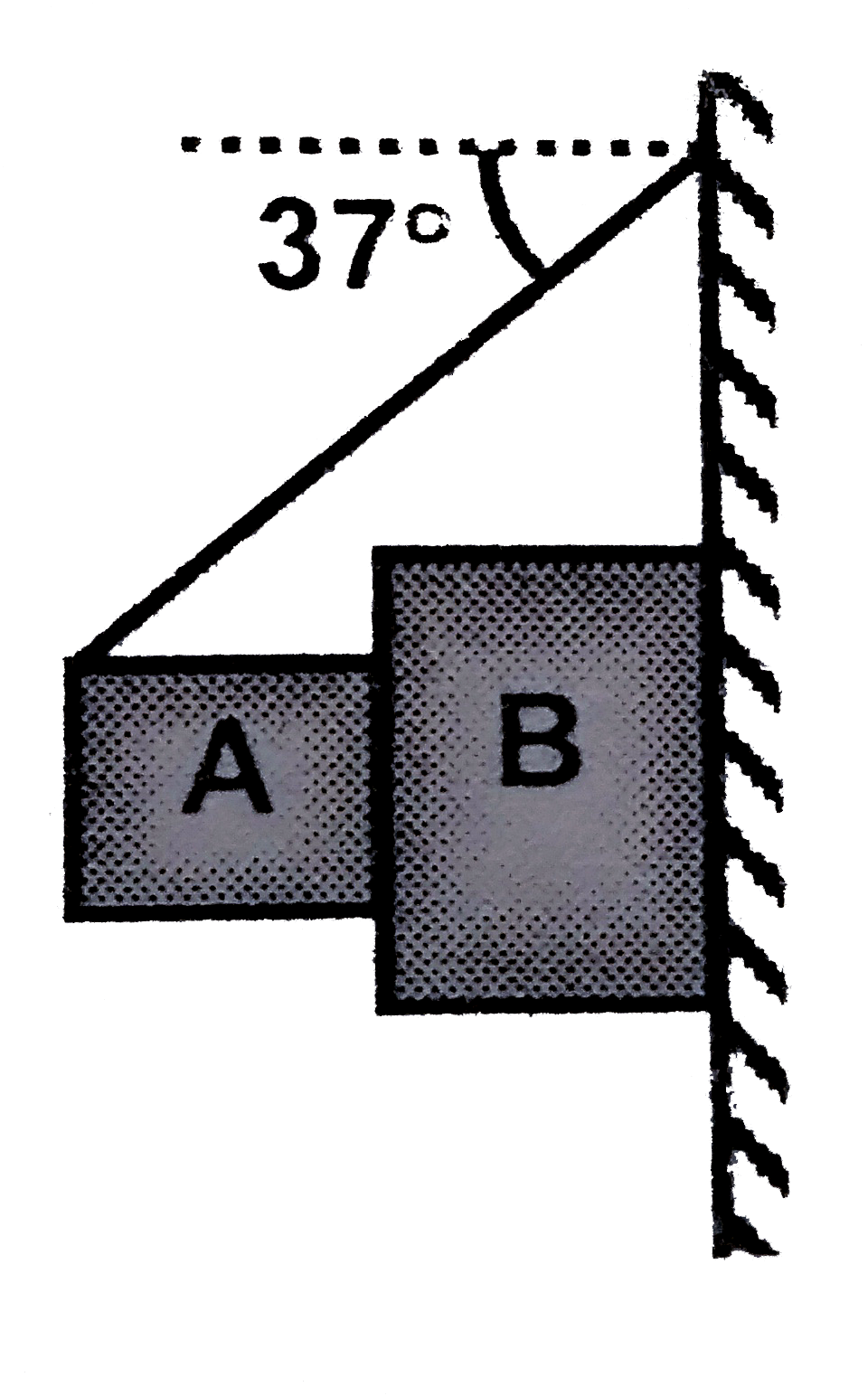
Two block A and B of mass `50 kg` and `300 kg` respectively are placed as shown in figure. Coefficient of friction between all surface is `(1)/(2)`
Then (take `g = 10 m//s`)

Text Solution

Verified by Experts

The correct Answer is:

`00033.33`
Promotional Banner

Similar Questions

Explore conceptually related problems

Three blocks of masses 5 kg, 3 kg and 2 kg are placed on a rough surface as shown in figure. Coefficient of friction between block and surface is same for all the blocks and is equal to mu = 0.2 . A horizontal force of 15 N is applied on 5 kg block. The force exerted by 3 kg block on 2 kg block is : (g = 10 m/ s^(2) )

Two bodies A and B of masses 10 kg and 5 kg placed very slightly seperated as shown in figure The coefficient of friction between the floor and the block are as mu_(s) = 0.4 block A is pushed by an external force F The value of F can be changed when the weight between block A and ground breaks block A will start prssing block B will start pressing the vertical wall If F = 50N the friction force acting between block B and ground will be

Two blocks a and B of mass m_(A)=1kg and m_(B)=3kg are kept on the table as shown in figure the coefficient of friction between A and B is 0.2 and between B and the surface of the table is also 0.2 the maximum force F that can be applied on B horizontally, so that the block A does not slide over the block B is [Take g=10m//s^(2) ]

Two blocks A and B of masses 2kg and 3kg are connected by a light string as shown in the figure and placed on a horizontal surface. mu between all surfaces is 0.1 and g = 10 ms^(-1) . The acceleration of the system is, when the force applied F = 45N

Blocks A and B each of mass 1kg are moving with 4m//s and 2m//s respectively as shown. The coefficient of friction for all surface is 0.10 . Find the distance (in m) by which centre of mass will travell before coming to rest. Assume large distance between the blocks

A force F is applied on a block of mass 5 kg as shown in figure. Co-efficient of friction between the wall and clock is (sqrt(3))/(2). (g = 10m//s^(2)) Select correct option(s)

Two blocks A and B of masses 10 kg and 15 kg are placed in contact with each other rest on a rough horizontal surface as shown in the figure. The coefficient of friction between the blocks and surface is 0.2. A horizontal force of 200 N is applied to block A. The acceleration of the system is ("Take g"=10ms^(-2))

Three blocks A , B and C , whose masses are 9kg , 9kg and 18kg respectively as shown in the figure, are released from rest. The co-efficient of friction between block A and the horizontal surface is 0.5 & the co-efficient of friction between block B and the horizontal surface is 0.5 . Find the acceleration of block C just release [Take g=10m//s^(2) ]. All strings and pulleys are ideal

A block of mass 50 kg slides over a horizontal distance of 1m. If the coefficient of friction between their surface is 0.2, then work done against friction is (take g = 9.8 m//s^(2) ) :

On a smooth table two blocks of masses 2.5kg and 1.5kg are placed one over the other as shown in figure. If the coefficient of static friction between two blocks is 0.2, the maximum horizontal force to be applied on the lower block so that the two blocks move together is (g = ms^(-2) )
