Home
Class 12
PHYSICS
A voltmeter has a range O - V with a ser...

A voltmeter has a range `O - V` with a series resistance `R`. With a series resistance `2R`, the range is `O - V'`. The correct relation between `V` and `V'`is

Text Solution

Verified by Experts
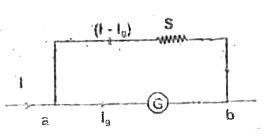
Here, galvanometer resistance `G = 3Omega` and full scale deflection current`I_(g) = 2 mA`
(a) To convert the galvanometer into an ammeter of range 0.3 ampere. a resistance of value .S. is connected in parallel with it such that the current through G should not be more than `I_(g)=0.3 A` and`(I-I_(g)` should pass through S.
`(I-I_(g) S = I_(g),G`
therefore `S=(I_(g)G)/(I-I_(g))=(2xx10^(3)xx30)/(0.3-2xx10^(-3))=0.2Omega`Hence, to convert the galvanometer into an ammeter of the desired range a shunt resistance (a small valued resistance) of `0.2Omega` is connected parallel to the meter. This shunt resistance gives us a low resistance instrument with a deflection current `l_(3)` - 0.3 ampere, while the current through the `galvanometer is 2 mA`
(b) To convert the galvanometer into a voltmeter of range 0.2 volt, a resistance R is. connected in series with it such that`V=I_(g)(R+G)i.e.0.2=2xx10^(-3)(30+R)`Or,R=100-30=70Ohms
Thus, to convert the galvanometer into a ! voltmeter of the desired range, a high resistance (R_(s)` is connected in series with the galvanometer. The equivalent meter resistance is `R_(eg) = 30 + 70 = 100 ohm` In this case, most of the voltage appears across the series resistor. The current through the voltmeter is 2 mA
Promotional Banner

Similar Questions

Explore conceptually related problems

A galvanometer has range 0 − V volt and it has resistance R. When the series resistor of resistance 2R is connected, the range becomes 0 ⋅ V . Then

A voltmeter has a resistance G and range V . Calculate the resistance to be used in series with it to extend its range to nV .

A voltmeter has a resistance G and range V . Calculate the resistance to be used in series with it to extend its range to nV .

A 1Omega voltmeter has range 1V find the additional resistance which has to join in series in voltmeter to increase the range of voltmeter to 100V :-

A resistor R is connected to a cell of emf e and internal resistance r. Potential difference across the resistor R is found to be V. State the relation between e, V, R and r.

A voltmeter of range 2 V and resistance 300 Omega cannot be converted into ammeter of range

Two batteries one of the emf 3V , internal resistance 1Omega and the other of emf 15 V , internal resistance 2Omega are connected in series with a resistance R as shown. If the potential difference between points a and b is zero, the resistance R in Omega is

A galvanmeter of resistance G is converted into a voltmeter of range 0 -1V by connecting resistance R_1 in series with it. The additional resistance that should be connected in series with R_1 to increase the range of the voltmeter to 0-2 V will be :

A 100 V voltmeter of internal resistance 20 k Omega in series with a high resistance R is connected to a 110 V line. The voltmeter reads 5 V , the value of R is

A voltmeter is connected in parallel with a variable resistance R which is in series with an ammeter and a cell as shown in the figure . For one value of R=2Ω,the reading are 0.25A and 1.0 V. What is the internal resistance of the cell ?

