Home
Class 12
PHYSICS
A thin uniform wire AB of length 1 m, an...

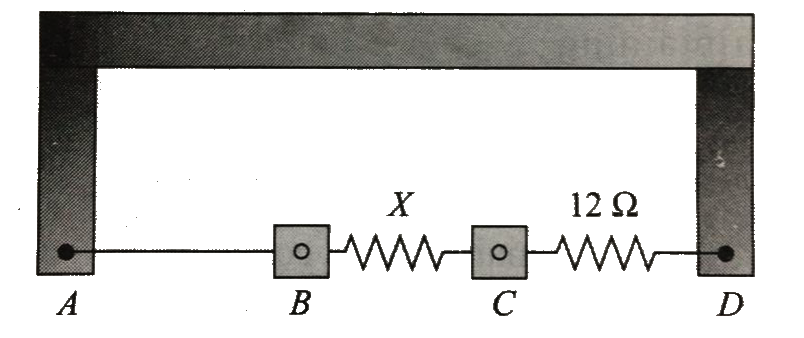
A thin uniform wire `AB` of length `1 m`, an unknown resistance `X`, and a resistance of `12 Omega` are connected by thick conducting strips, as shows in Fig. `6.27`. A battery and a galvanometer (with a sliding jockey connected to it) are also available. Connections are to be made to measure the unknows resistance `X` using the principle of wheatstone bridge. Answer the following question.

(i) Are three positive and negative terminals on the galvanometer ?
(ii) Copy the figure in your answer book and show the battery and the galvanometer (with jockey) connected at appropriate points.
(iii) After appropriate connections are made, it is found that no deflection takes place in the galvanometer when the slider jockey touches the wire at a distance of `60 cm` from `A`. Obtain the value of the resistance `X`.

Text Solution

Verified by Experts
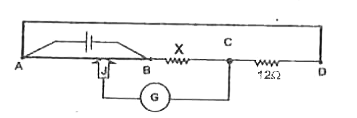
No,(b)
(c)Bridge is balanced`(R_(AJ))/(R_(JU))=(0.6p)/(0.4p)=(12Omega)/(x)impliesX=8Omega` where p is resistance per unit length

Promotional Banner

Similar Questions

Explore conceptually related problems

A thin uniform wire AB of length 1 m , an unknown resistance X and a resistance of 12 Omega are connected by thick conducting strips, as shown in the figure. A battery and a galvanometer (with a sliding jockey connected to it) are also available. Connections are to be made to measure the unknown resistance X . Using the principle of Wheatstone bridge answer the following questions : (a) Are there positive and negative terminals on the galvanometer? (b) Copy the figure in your answer book and show the battery and the galvanometer (with jockey connect at appropriate points. (c) After appropriate connections are made, it is found that no deflection takes place in th, from galvanometer when the sliding jockey touches the wire at a distance of 60 cm from A . Obtain value of the resistance X.

A thin uniform wire AB of length 1 m , an unknown resistance X and a resistance of 12 Omega are connected by thick conducting strips, as shown in the figure. A battery and a galvanometer (with a sliding jockey connected to it) are also available. Connections are to be made to measure the unknown resistance X . Using the principle of Wheatstone bridge answer the following questions : (a) Are there positive and negative terminals on the galvanometer? (b) Copy the figure in your answer book and show the battery and the galvanometer (with jockey connect at appropriate points. (c) After appropriate connections are made, it is found that no deflection takes place in th, from galvanometer when the sliding jockey touches the wire at a distance of 60 cm from A . Obtain value of the resistance X.

A single battery is connected to three resistances as shown in fig. 5.316

Can we measure a resistance of the order of 0.160 Omega using a Wheatstone's bridge ? Support your answer with reasoning.

In a wheatstone bridge resistance of each of the four sides is 10Omega . If the resistance of the galvanometer is also 10Omega , then effective resistance of the bridge will be

In the circuit shows in Fig. 6.20 , a meter bridge is in its balance state. The meter bridge wire has a resistance of 1 Omega cm^(-1) . Calculate the value of the unknow resistance X and current drawn from the battery of negligible internal resistance.

A resistance box, a battery and a galvanometer of resistance G ohm are connected in series. the galvanometer is shunted by resistance of S ohm, find the change in resistance in the be required to maintain the current from the battery unchanged.

In the circuit shows in Fig. 6.42 , resistors X and Y , each with resistance R , are connected to a 6 V battery of negligible internal resistance. A voltmeter, also of resistance R , is connected across Y . What is the reading of the voltmeter?

The resistance of each arm of the wheat stone bridge is 10Omega . A resistance of 10Omega is connected in series with galvanometer then the equivalent resistance across the battery will be:-

To measure the resistance of a galvanometer by half deflection method, a shunt is connected to the galvanometer . The shunt is