Home
Class 12
PHYSICS
Consider a Wheatstone bridge with resist...

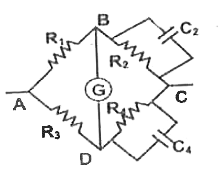
Consider a Wheatstone bridge with resistance and capacitance connected as shown Find the condition on the resistance and the capacitance such that the bridge remains balanced at all times.

Text Solution

Verified by Experts
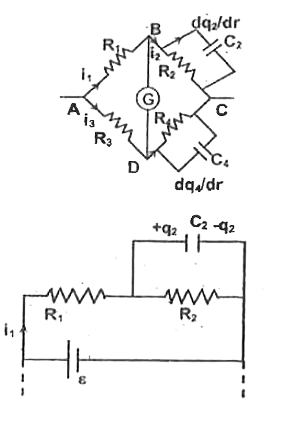
Suppose that the bridge is balanced i.e. `V_(AB) = V_(AD)` and `V_(BC) = V_(DC)`Let the current and the charges on the capacitors in the circuit as shown then
`I_(1)R_(1)=I_(3)R_(3)ldot`s(i)
`(q_(2)/(C_(2))=(q_(4)/(C_(4))`ldots(ii)
Consider the charging of the part of the circuit shown alongside. Let qz be the charge on `C_(2)` and `i_(1)` be the current in the circuit. Then
`I_(1)R_(1)+q_(2)/(C_(2))=epsilonldots(iii)`
`(dq_(2))/(dt)+(q_(2))/(R_(2)C-(2))=i_(1)ldots(iv)`
Substituting (iv) in (ill) and simplifying
`(dq_(2))/(dt)+(q_(2))/(R_(eq)C_(2))=(epsilon)/(R_(1))`where`(1)/(R_(eq))=(1)/(R_(1))+(1)/(R_(2))`
therefore`q_(2)=(epsilonR_(4)C_(4))/(R_(1))[1-e^((1)/(R_(EqC_(4)))]]=(epsilonR_(2)C_(2))/R_(1)+R_(2)[1-e^(-1//R_(eqC_(2))]]`
Similarly, for the other circuit, we have`q_(4)=(epsilonR_(4)C_(4))/(R_(3)+R_(4))[1-e^(1)/(R_(eq)C_(4))]`,where`(1)/(R_(eq))=(1)/(R_(3))+(1)/(R_(4))`
NOW,`(q_(2))/(C_(2))=(q_(4)/C-(4))`,which leads to
`(R_(2))/(R_(1)+R_(2))=(R_(4))/(R_(3)+R_(4))`and`(1)/(R_(eq)C_(2))=(1)/(R_(eq)C_(2))Or(R_(1))/(R_(2))=(R_(3))/(R_(4))`and`R_(1)C_(2)=R_(3)C_(4)`
Promotional Banner

Similar Questions

Explore conceptually related problems

Find the capacitance in shown figure

A capacitance C is connected to two equal resistance as shown in the figure. Then

There is no resistance in the capacitive circuit shown. Then charge on the capacitor at an time t

In a Wheatstone's bridge, three resistances P,Q and R connected in the three arms and the fourth arm is formed by two resistances S_1 and S_2 connected in parallel. The condition for the bridge to be balanced will be

In a Wheatstone's bridge, three resistances P,Q and R connected in the three arms and the fourth arm is formed by two resistances S_1 and S_2 connected in parallel. The condition for the bridge to be balanced will be

In a wheatstone bridge resistance of each of the four sides is 10Omega . If the resistance of the galvanometer is also 10Omega , then effective resistance of the bridge will be

In a Wheatstone bridge, three resistance, P, Q and R are connected in the three arms and fourth arm is formed by two resistance s_(1) and s_(2) connected in parallel. The condition for the bridge to be balanced for ratio ((p)/(Q)) is (given R=10Omega, S_(1)=6Omega, S_(2)=3Omega )

In a Wheatstone bridge, three resistance, P, Q and R are connected in the three arms and fourth arm is formed by two resistance s_(1) and s_(2) connected in parallel. The condition for the bridge to be balanced for ratio ((p)/(Q)) is (given R=10Omega, S_(1)=6Omega, S_(2)=3Omega )

The figure below shows a wheatstone bridge with resistors P and Q having almost equal resistance. When R = 400 Omega , the bridge is in balanced condition. If on interchanging P and Q, the bridge is again balanced for R = 405 Omega , then the value of X is

All the capacitances shown in figure are in muF . Find the equivalent capacitance between A and B.

