Home
Class 12
PHYSICS
A cylindrical conductor has uniform cros...

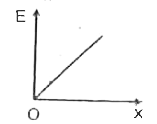
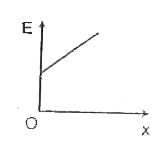
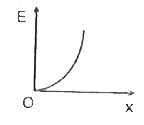
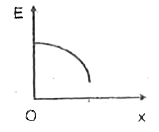
A cylindrical conductor has uniform cross-section. Resistivity of its material increase linearly from left end to right end. If a constant current is flowing through it and at a section distance x from left end, magnitude of electric field intensity is E , which of the following graphs is correct

A


B


C


D

Text Solution

AI Generated Solution

The correct Answer is:

To solve the problem, we need to analyze the relationship between the electric field intensity \( E \) and the distance \( x \) from the left end of the cylindrical conductor, given that the resistivity \( \rho \) increases linearly along the length of the conductor. ### Step-by-step Solution: 1. **Understanding Resistivity Variation**: The resistivity \( \rho \) of the material increases linearly from the left end to the right end. We can express this mathematically as: \[ \rho(x) = \rho_0 + \alpha x \] where \( \rho_0 \) is the resistivity at the left end (at \( x = 0 \)), \( \alpha \) is a constant that describes how resistivity changes with distance, and \( x \) is the distance from the left end. 2. **Using Ohm's Law**: The electric field intensity \( E \) in a conductor is related to the current \( I \), resistivity \( \rho \), and the cross-sectional area \( A \) by the formula: \[ E = \frac{I \cdot \rho}{A} \] Since \( \rho \) varies with \( x \), we can substitute our expression for \( \rho(x) \) into this equation: \[ E(x) = \frac{I \cdot (\rho_0 + \alpha x)}{A} \] 3. **Simplifying the Expression**: We can separate the terms in the equation: \[ E(x) = \frac{I \cdot \rho_0}{A} + \frac{I \cdot \alpha}{A} x \] Here, \( \frac{I \cdot \rho_0}{A} \) is the y-intercept of the graph, and \( \frac{I \cdot \alpha}{A} \) is the slope of the line. 4. **Graph Interpretation**: The equation \( E(x) = mx + c \) indicates that the graph of \( E \) versus \( x \) will be a straight line with: - A positive slope \( m = \frac{I \cdot \alpha}{A} \) - A y-intercept \( c = \frac{I \cdot \rho_0}{A} \) 5. **Conclusion**: Since the resistivity increases linearly, the electric field intensity \( E \) will also increase linearly with \( x \). Therefore, the correct graph will be a straight line starting from a positive y-intercept and increasing as \( x \) increases. ### Correct Graph: Among the options provided, the graph that represents a straight line with a positive slope and a positive y-intercept is option B.

To solve the problem, we need to analyze the relationship between the electric field intensity \( E \) and the distance \( x \) from the left end of the cylindrical conductor, given that the resistivity \( \rho \) increases linearly along the length of the conductor. ### Step-by-step Solution: 1. **Understanding Resistivity Variation**: The resistivity \( \rho \) of the material increases linearly from the left end to the right end. We can express this mathematically as: \[ \rho(x) = \rho_0 + \alpha x ...
Promotional Banner

Similar Questions

Explore conceptually related problems

A rod has non uniform mass distribution. The mass increases uniformly from left end (A) to right end (B) . It is most difficult to rotate the rod about as axis

A conductor is made of an isotropic material and has shape of a truncated cone. A battery of constant emf is connected across it and its left end is earthed as shown. If at a certain section at a distance x form left end, electric field intensity and the rate of generation of heat per unit length are E and H respectively, which of the following graphs is (are) correct?

E denotes electric field in a uniform conductor, I corresponding current through it, v_(d) velocity of electrons and P denotes thermal power produced in the conductor, then which of the following graph is correct?

A conductor of length l has a non-uniform cross-section. The radius of cross-section varies linearly from a to b . The resistivity of the material is rho . Find the resistance of the conductc across its ends.

A rod of length L is of non uniform cross-section. Its mass per unit length varies linearly with distance from left end. Then its centre of mass from left end is at a distance. (Take linear density at left end=0).

A conductor of length L is placed along the x - axis , with one of its ends at x = 0 and the other at x = L. If the rate of flow of heat energy through the conduct is constant and its thermal resistance per unit length is also constant , then Which of the following graphs is/are correct ?

Two cylindrical conductors with equal cross-sections and different resistivites rho_(1) and rho_(2) are point end to end. Find the charge at the boundary of the conduction if a current I flows from conductor 1 to conductor 2

A cylindrical conductor has length l and area of cross section A. Its conductivity changes with distance (x) from one of its ends as sigma = sigma_(0) (l)/(x). [sigma_(0) "is a constant"] . Calculate electric field inside the conductor as a function of x , when a cell of emf V is connected across the ends.

A conductor of resistivity rho and resistance R, as shown in the figure, is connected across a battery of emf V. Its radius varies from a at left end to b at right end. The electric field at a point P at distance x from left end of it is

A uniform rod of length l is being rotated in a horizontal plane with a constant angular speed about an axis passing through one of its ends. If the tension generated in the rod due to rotation is T(x) at a distance x from the axis. Then which of the following graphs depicts it most closely?
