Home
Class 12
PHYSICS
Three ammeters 1, 2, and 3 of resistance...

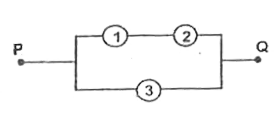
Three ammeters 1, 2, and 3 of resistances `R_(1). R_(2) and R_(3)` respectively are joined as shown. When some potential difference is applied across the terminals P and Q, their readings are `I_(1), I_(2) and I_(3)`, respectively. Then

A

`I_(1)=I_(2)`

B

`I_(1)R_(1)+I_(2)R_(2)=I_(3)R_(3)`

C

`(I_(1))/(I_(2))=(R_(3))/(R_(1))`

D

`(I_(2))/(I_(3))=(R_(3))/(R_(1)+R_(2))`

Text Solution

Verified by Experts

The correct Answer is:

A, B, D
Promotional Banner

Similar Questions

Explore conceptually related problems

Three ammeters A,B , and C of resistances R_A,R_b and R_C respectively are joined as shown. When some potential difference is appllied across the terminals T_1 and T_2 their readings are I_A,I_B and I_C respectively Then,

Three voltmeters A, B and C having resistances R, 1.5 R and 3 R respectively are used in a circuit as shown. When a potential difference is applied between X and Y, the readings of the voltmeters are V_1, V_2 and V_3 respectively. Then :

Three voltmeters all having different resistance, are joined as shown. When some potential difference is applied acros A and B , their readings are V_1,V_2 and V_3. Then

A, B and C are voltmeters of resistances R, 1.5R and 3R respectively. When some potential difference is applied between x and y the voltmeter readings are V_A, V _B and V_C, then

A, B and C are voltmeters of resistances R, 1.5R and 3R respectively. When some potential difference is applied between x and y the voltmeter readings are V_A, V _B and V_C, then

A, B and C are voltmeters of resistances R, 1.5R and 3R respectively. When some potential difference is applied between x and y the voltmeter readings are V_A, V _B and V_C, then

A, B and C are voltmeters of resistances R, 1.5R and 3R respectively. When some potential difference is applied between x and y the voltmeter readings are V_A, V_B and V_C, then

In the situation shown, resistance R_(1),R_(2) and R_(3) are in the ratio 3:2:1 , then

If I is the incenter of Delta ABC and R_(1), R_(2), and R_(3) are, respectively, the radii of the circumcircle of the triangle IBC, ICA, and IAB, then prove that R_(1) R_(2) R_(3) = 2r R^(2)
