Home
Class 12
PHYSICS
A composite rod (formed by joining two r...

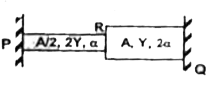
A composite rod (formed by joining two rods of equal length l but different materials) is held between two fixed supports as shown. If temperature of the system is lowered by `Deltatheta`, then the displacement of the contact point R is (Symbols or having their usual meanings)

A

`2alpha l Deltatheta`

B

`alpha l Deltatheta`

C

`(alpha l Deltatheta)/2`

D

`(alphalDeltatheta)/4`

Text Solution

Verified by Experts

The correct Answer is:

C
Promotional Banner

Similar Questions

Explore conceptually related problems

Centre of mass of two unifrom rods of same length but made up of different materials & kept as shown, if the meeting point is the origin of co-ordinates :-

A rod of length / and radius r is held between two rigid walls so that it is not allowed to expand. If its temperature is increased, then the force developed in it is proportional to

A rod of aluminium is fixed between two rigid support. If the temperature of rod is increased by 10°C , then the thermal stress on the rod is (Take Y= 7×10^10 Pa and alpha =2.4* 10^-5 K^-1 )

Four rods of same material and having the same cross section and length have been joined, as shown. The temperature of the junction of four rods will be :

Two uniform rods of equal length but different masses are rigidly joined to form an L-shaped body, which is then pivoted as shwon. If in equilibrium, the body is in the shown configuration, ratio M//m will be

Four rods A, B, C and D ) of the same length and material but of different radii r, rsqrt(2),rsqrt(3) and 2r , respectively, are held between two rigid walls. The temperature of all rods is increased through the same range. If the rods do not bend, then

Two rods A and B of different materials are welded together as shown in figure. Their thermal conductivities are K_(1) and K_(2) . The thermal conductivity of the composite rod will be

A composite rod is made by joining a copper rod, end to end, with a second rod of different material but of the same area of cross section. At 25^(@)C , the composite rod is 1 m long and the copper rod is 30 cm long. At 125^(@)C the length of the composite rod increases by 1.91 mm . When the composite rod is prevented from expanding by holding it between two rigid walls, it is found that the constituent rods have remained unchanged in length inspite of rise of temperature. Find young's modulus and the coefficient of linear expansion of the second rod (Y of copper =1.3xx10^(10) N//m^(2) and a of copper =17xx10^(-6)//K ).

A composite rod is made by joining a copper rod, end to end, with a second rod of different material but of the same area of cross section. At 25^(@)C , the composite rod is 1 m long and the copper rod is 30 cm long. At 125^(@)C the length of the composte rod increases by 1.91 mm . When the composite rod is prevented from expanding by bolding it between two rigid walls, it is found that the constituent reds have remained unchanged in length in splite of rise of temperature. Find yong's modulus and the coefficient of linear expansion of the second red (Y of copper =1.3xx10^(10) N//m^(2) and a of copper =17xx10^(-6)//K ).

A metal rod has length L, radius of its cross-section r. Youngs modulus Y and thermal coefficient of linear expansion is α.It is clamped between two rigid supports with negligible tension. If its temperature is increased by T^@C , then force exerted by the rod on any of the supports is
