Two moles of an ideal monoatomic gas are contained in a vertical cylinder of cross sectional area `A` as shown in the figure. The piston is frictionless and has a mass m. At a certain instant a heater starts supplying heat to the gas at a constant rate `q J//s`. Find the steady velocity of the piston under isobaric condition. All the boundaries are thermally insulated.
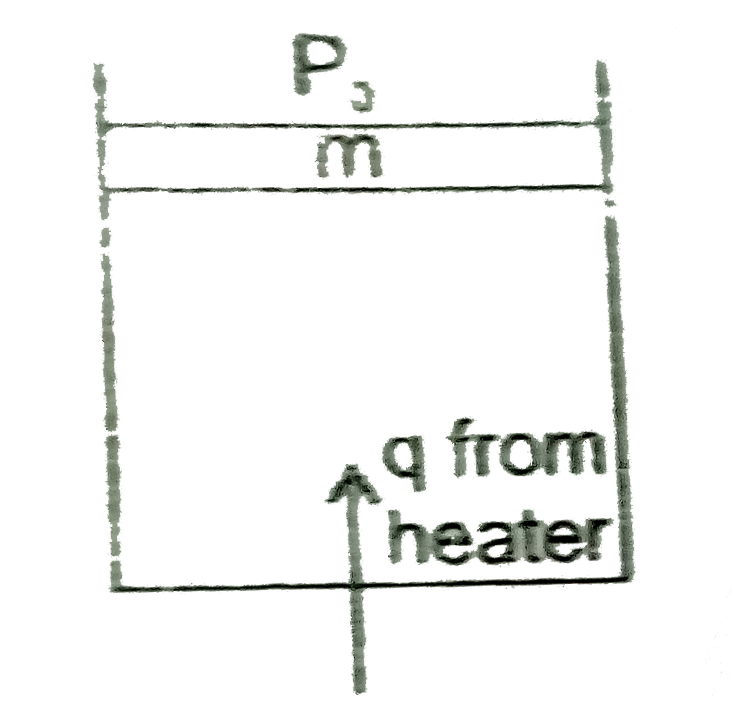
Two moles of an ideal monoatomic gas are contained in a vertical cylinder of cross sectional area `A` as shown in the figure. The piston is frictionless and has a mass m. At a certain instant a heater starts supplying heat to the gas at a constant rate `q J//s`. Find the steady velocity of the piston under isobaric condition. All the boundaries are thermally insulated.
Text Solution
Verified by Experts
The correct Answer is:
`2/5q/([p_0A+mg])`



Similar Questions
Explore conceptually related problems
A vertical cylinder of cross-section area A contains one mole of an ideal mono-atomic gas under a piston of mass M At a certain instant a heater which supplies heat at the rate q J//s is switched ON under the piston. The velocity with which the piston moves upward under the condition that pressure of gas remains constant is [Assume on heat transfer through walls of cylinder]
2 moles of a diatomic gas are enclosed in a cylinder piston arrangment. The area of cross section and mass of the piston are 1 cm^(2) and 1 kg respectively. A heater is supplying heat to the gas very slowly. Find heat supplied (in joule) by the heater is the piston moves through a distance of 10 cm. .
Two moles of an ideal gas are contained in a vertical cylinder with a frictionless piston. The piston is slowly displaced so that expansionin gas is isothermal at temperature T_(0)=400 K. find the amount of work done in increasing the volume to 3 times.t ake atmospheric pressure =10^(5)N//m^(2)
Two moles of an ideal monoatomic gas are confined within a cylinder by a massless and frictionless spring loaded piston of cross-sectional area 4 xx 10^(-3)m^(2) . The spring is, initially in its relaxed state. Now the gas is heated by an electric heater, placed inside the cylinder, for some time. During this time, the gas expands and does 50J of work in moving the piston through a distance 0.10m . The temperature of the gas increases by 50K . Calculate the spring constant and the heat supplied by the heater. P_(atm) = 1 xx 10^(5)N//m^(2)R = 8.314 J//mol-K
Figure shows initial state of an ideal gas trapped in a container with conducting walls and a piston (mass m ) which can move without any friction. The container is placed on point supports and its wall are conducting. Assuming that atmospheric pressure is P_(0) and the mass of the ideal gas is negligible as compared to the mass of the piston and the mass of container. Take the cross section area of piston to be A. The piston is slowly lifted by an external agent and held in its position. Let M be the maximum mass of container so that it may "lift off" while pulling the piston upwards and P_(i) be the pressure of ideal gas in initial state. Pick the correct choice:
Passage XIV) A uniform cylindrical block of mass 2M and cross-sectional area A remains partially submerged in a non viscous liquid of density rho , density of the material of the cylinder is 3rho . The cylinder is connected to lower end of the tank by means of a light spring of spring constant K. The other end of the cylinder is connected to anotehr block of mass M by means of a light inextensible sting as shown in the figure. The pulleys shown are massless and frictionless and assume that the cross-section of the cylinder is very small in comparison to that of the tank. Under equilibrium conditions, half of the cylinder is submerged. [given that cylinder always remains partially immersed) Under equilibrium conditions
A block of mass M and cylindrical tank which contains water having small hole at bottom, which is closed initially (total mass of cylinder + water is also M), are attached at two ends of an ideal string which passes over an ideal pulley as shown. At t = 0 hole is opened such that water starts coming out of the hole with a constant rate mu kg//s and constant velocity V_(e) relative to the cyliender. aSccleration of the block at any time t will be : (Given that string always remains taut.)
Passage XIV) A uniform cylindrical block of mass 2M and cross-sectional area A remains partially submerged in a non viscous liquid of density rho , density of the material of the cylinder is 3rho . The cylinder is connected to lower end of the tank by means of a light spring of spring constant K. The other end of the cylinder is connected to anotehr block of mass M by means of a light inextensible sting as shown in the figure. The pulleys shown are massless and frictionless and assume that the cross-section of the cylinder is very small in comparison to that of the tank. Under equilibrium conditions, half of the cylinder is submerged. [given that cylinder always remains partially immersed) If the cylinder is pushed down from equilibrium by a distance which is half the distance as calculated in the above question, determine time period of subsequent motion.
Passage XIV) A uniform cylindrical block of mass 2M and cross-sectional area A remains partially submerged in a non viscous liquid of density rho , density of the material of the cylinder is 3rho . The cylinder is connected to lower end of the tank by means of a light spring of spring constant K. The other end of the cylinder is connected to anotehr block of mass M by means of a light inextensible sting as shown in the figure. The pulleys shown are massless and frictionless and assume that the cross-section of the cylinder is very small in comparison to that of the tank. Under equilibrium conditions, half of the cylinder is submerged. [given that cylinder always remains partially immersed) By what maximum distance cylinder will be pushed downward into the liquid from equilibrium position so that when it is set free then tension in the string will not vanish [Assume at equilibrium position system was at rest]
An ideal monoatomic gas is enclosed in a fixed horizontal adiabatic cylinder of cross sectional area A. The cylinder is fitted with an adiabatic piston of mass m (attached to one end of a spring as shown) which can move horizontally without friction inside the cylinder. In equilibrium, the spring is in natural length and pressure and volume are P_0 and V_0 respectively. The piston is slightly displaced from equilibrium and released. Then, frequency of small oscillation is
Recommended Questions
- Two moles of an ideal monoatomic gas are contained in a vertical cylin...
Text Solution
|
- In the arrangement shown in Fig. gas is thermally insulated. An ideal ...
Text Solution
|
- A vertical cylinder of cross-section area A contains one mole of an id...
Text Solution
|
- A cylinder fitted with a piston contains an ideal monoatomic gas at a ...
Text Solution
|
- Two moles of an ideal monoatomic gas are contained in a vertical cylin...
Text Solution
|
- A vertical cylinder pistion system has cross-section S. It contains 1 ...
Text Solution
|
- A horizontal cylinder has two sections of unequal cross - sections, in...
Text Solution
|
- 2 moles of a diatomic gas are enclosed in a cylinder piston arrangment...
Text Solution
|
- Two moles of an ideal monoatomic gas are confined within a cylinder by...
Text Solution
|