Home
Class 12
PHYSICS
Two fixed insulating rings A and B carry...

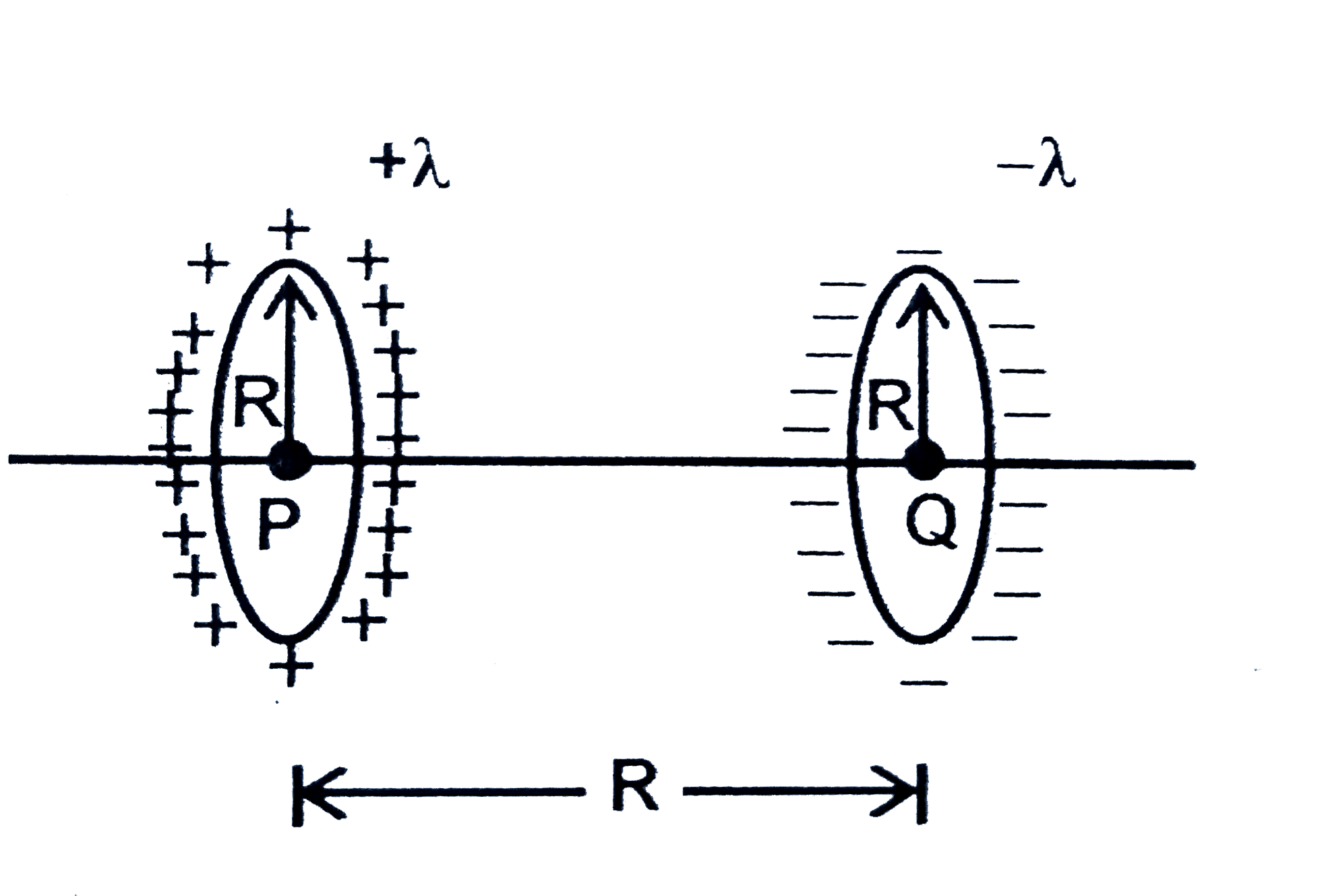
Two fixed insulating rings A and B carry charges with uniform linear charge density `+lambda` and `-lambda`, respectively, as shown in the adjacent figure. The planes of the rings are parallel to each other and their axes are coinciding. A particle of change "q" and mass "m" is released with zero velocity from centre P of the positively charged ring. The kinetic energy of the particle when it reaches centre Q of the negatively charge ring will be

A

`sqrt((2lambdaq)/(m in_0)(1-1/sqrt2))`

B

`lambda/in_0 (1-1/sqrt2)q`

C

`lambda/(2in_0)(1-1/sqrt2)q`

D

none of the above

Text Solution

Verified by Experts

The correct Answer is:

B
Promotional Banner

Similar Questions

Explore conceptually related problems

Two fixed insulating rings A and B carry ahanges with uniform linear aharge density +lambda and -lambda , respectively, as shown in the adjacent figure. The planes of the rings are parallel to each other and their axes are coinciding. A particle of change "q" and mass "m" is released with zero velocity from centre P of the positively charged ring. The kinetic energy of the particle when it reaches centre Q of the negatively charge ring will be

A charged particle of mass m and charge q is released from rest in an electric field of constant magnitude E . The kinetic energy of the particle after time t is

A ring of radius R carries a non - uniform charge of linear density lambda = lambda_(0)costheta sec in the figure) Magnitude of the net dipolement of the ring is :

The change in the kinetic energy of a charged particle moving in a uniform magnetic field will be zero when its velocity is

A particle of mass m and charge q is placed at rest in a uniform electric field E and then released, the kinetic energy attained by the particle after moving a distance y will be

Centre of mass of a ring will be at a position:

A point charge of charge -q and mass m is released with negligible speed from a distance sqrt(3) R on the axis of a fixed uniformly charged ring of charge Q and radius R. Find out its velocity when it reaches it reaches at the centre of the ring.

If linear charge density of a wire as shown in the figure is lambda

A long straight wire carries a charge with linear density lamda . A particle of mass m and a charge q is released at a distance r from the the wire. The speed of the particle as it crosses a point distance 2r is

Two identical coaxial rings each of radius R are separated by a distance of sqrt3R . They are uniformly charged with charges +Q and -Q respectively. The minimum kinetic energy with which a charged particle (charge +q ) should be projected from the centre of the negatively charged ring along the axis of the rings such that it reaches the centre of the positively charged ring is
