Home
Class 12
PHYSICS
The earth is moving on an elliptical pat...

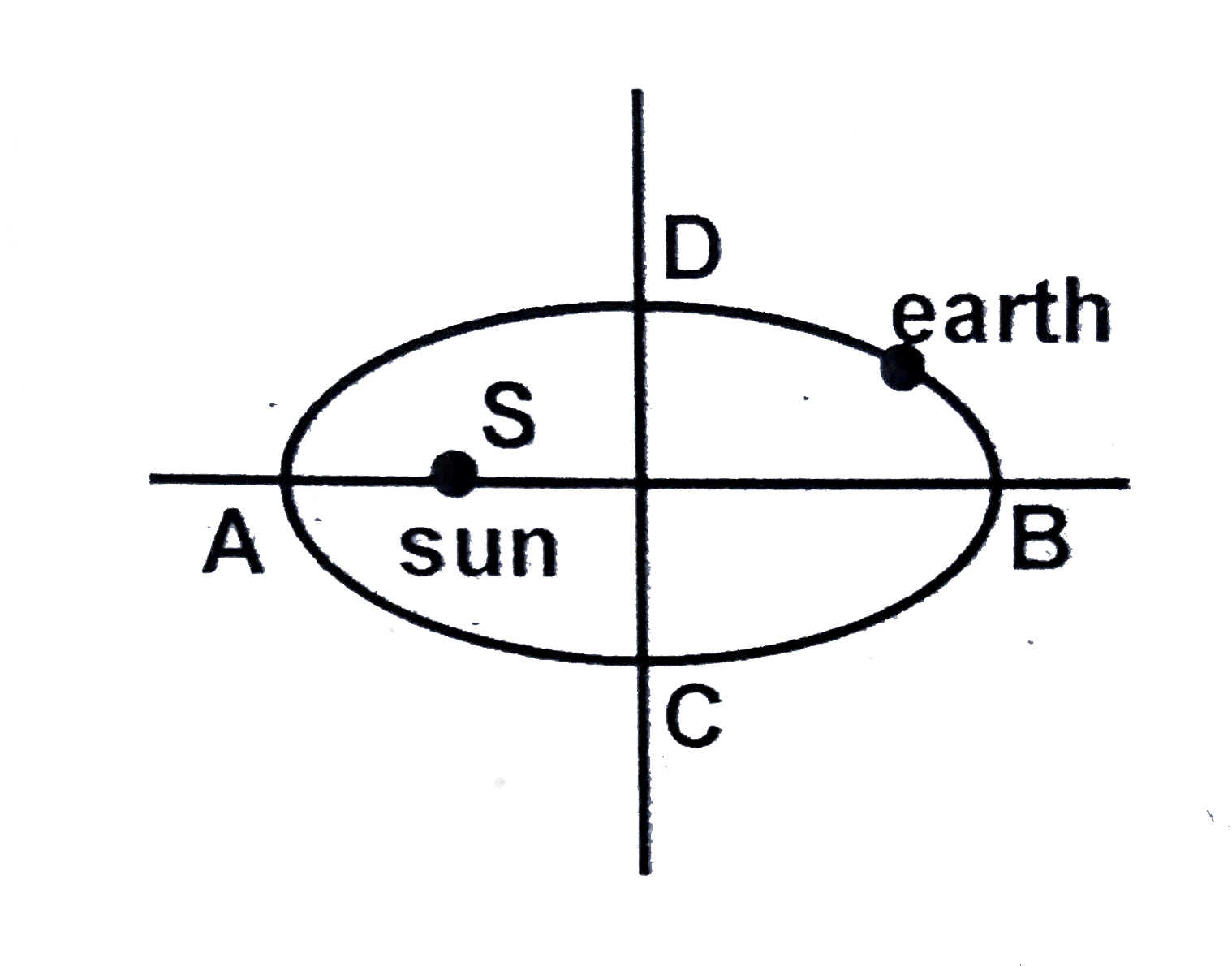
The earth is moving on an elliptical path, whose one focus sun is situated as shown in figure. If `AS = r_(min)` and `SB = r_(max)`, the sun and earth system obey the Kepler's law, the square of time-period is directly proportional to

A

`(r_("min"))^3`

B

`(r_("max"))^3`

C

`((r_("min")+r_("max"))/2)^3`

D

`((r_("min")r_("max"))/(r_("min")+r_("max")))^3`

Text Solution

Verified by Experts

The correct Answer is:

C
Promotional Banner

Similar Questions

Explore conceptually related problems

A planet of mass m is moving in an elliptical orbit about the sun (mass of sun = M). The maximum and minimum distances of the planet from the sun are r_(1) and r_(2) respectively. The period of revolution of the planet wil be proportional to :

A planet is moving in an elliptical path around the sun as shown in figure. Speed of planet in positions P and Q are V_(1) and V_(2) respectively with SP=r_(1) and SQ=r_(2) , then v_(1)//v_(2) is equal to

Two hypothetical planets 1 and 2 are moving in the same eliptical path as shown in the figure. If the planets are situated at minimum and maximum distance from the sun and one of the planet, say 1 , has speed v . Find the relative angular speed of the planets for the given situation.

Figure shows the motion of a planet around the Sun S in an elliptical orbit with the Sun at the focus. The shaded areas A and B are also shown in the figure which can be assumed to be equal. If t_(1) and t_(2) represent the time taken for the planet to move from a to b and c to d , respectively then

Figure shows the motion of a planet around the Sun S in an elliptical orbit with the Sun at the focus. The shaded areas A and B are also shown in the figure which can be assumed to be equal. If t_(1) and t_(2) represent the time taken for the planet to move from a to b and c to d , respectively then

Kepler's law starts that square of the time period of any planet moving around the sun in an elliptical orbit of semi-major axis (R) is directly proportional to

Statement I: The smaller the orbit of a planet around the Sun, the shorter is the time it takes to complete. Statement II: According to Kepler's third law of planetary motion, square of time period is proportional to cube of mean distance from Sun.

A planet of mass m moves around the Sun of mass Min an elliptical orbit. The maximum and minimum distance of the planet from the Sun are r_(1) and r_(2) , respectively. Find the relation between the time period of the planet in terms of r_(1) and r_(2) .

Which of the diagrams shown in figure. Most closely shows the variation inkinetic energy of the earth as it moves once around the sun in its elliptical orbit ?

The motion of a planet around sun in an elliptical orbit is shown in the following figure. Sun is situated at one focus. The shaded areas are equal. If the planet takes time t_1 and t_2 in moving from A to B and from C to D respectively, then
