Home
Class 12
PHYSICS
A pendulum of length 1 m hangs from an i...

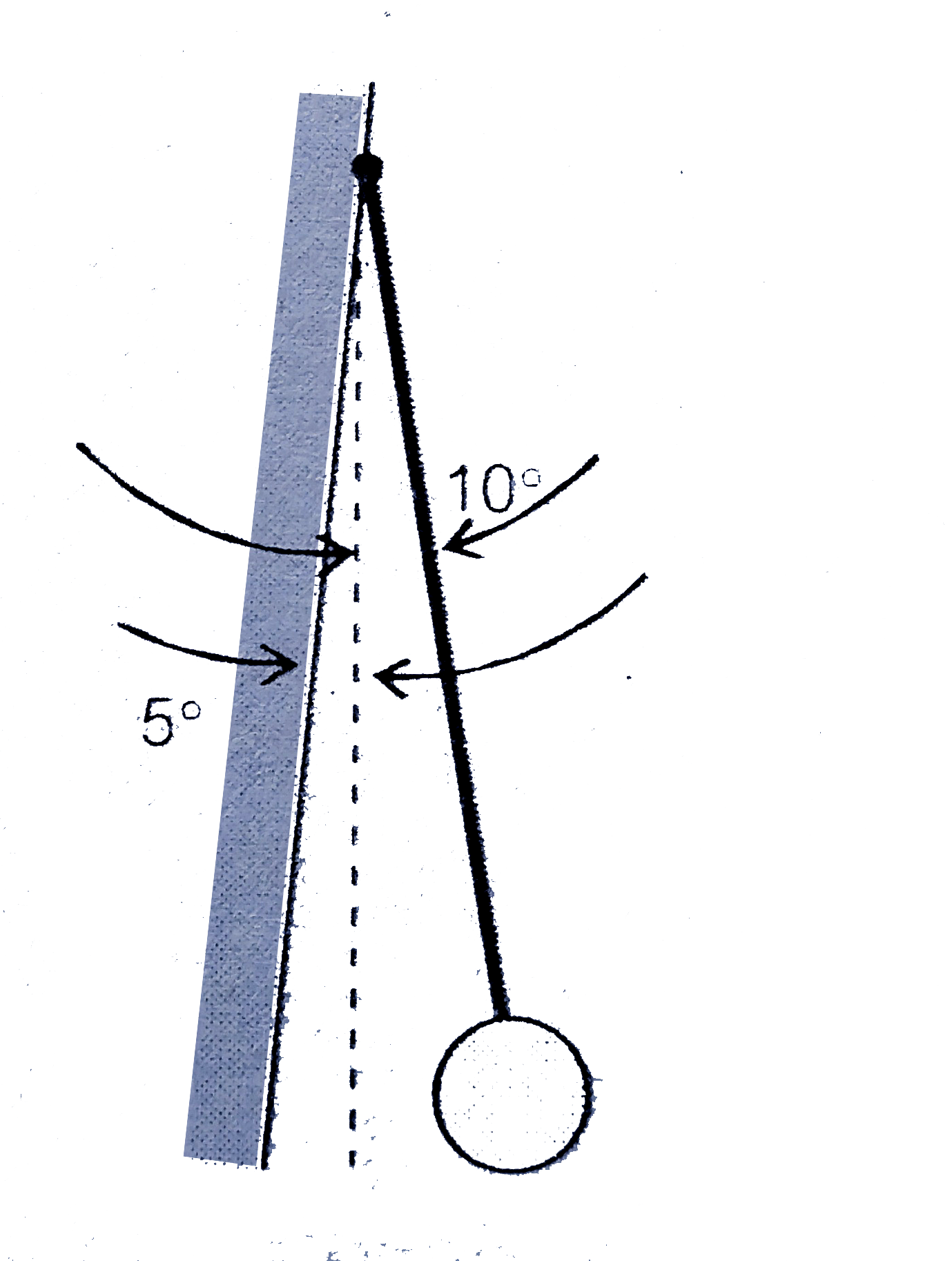
A pendulum of length `1 m` hangs from an inclined wall. Suppose that this pendulum is released at an initial angle of `10^(@)` and it bounces off the wall elastically when it reaches an angle of `-5^(@)` as shown in the figure. Take `g = pi^(2) m//s^(2)`. The period of this pendulum is (in second)

Text Solution

Verified by Experts

The correct Answer is:

`00000.75`
Promotional Banner

Similar Questions

Explore conceptually related problems

Find the length of seconds pendulum at a place where g = pi^(2) m//s^(2) .

A partile is projected up an incline (inclination angle = 30^(@) ) with 15sqrt(3) m//s at an angle of 30^(@) with the incline (as shown in figure) (g = 10 m//s^(2))

Find the length of seconds pendulum at a place where g =4 pi^(2) m//s^(2) .

A simple pendulum is released from A as shown. If m and 1 represent the mass of the bob and length of the pendulum, the gain kinetic energy at B is

A pendulum bob has a speed of 3ms^(-1) at its lowest position. The pendulum is 0.5 m long. The speed of the bob, when string makes an angle of 60^(@) to the vertical is ("take, g"=10ms^(-1))

A simple pendulum of length 1m is attached to the ceiling of an elevator which is accelerating upward at the rate of 1m//s^(2) . Its frequency is approximately :-

A pendulum bob has a speed 3m/s while passing through its lowest position. What is its speed when it makes an angle of 60^0 with the vertical? The length of the pendulum is 0.5m Take g=10 m/s^2 .

A simple pendulum of length 5 m is suspended from the ceiling of a cart. Cart is sliding down on a frictionless surface having angle of inclination 60°. The time period of the pendulum is

A simple pendulum is suspended from the ceiling of a car taking a turn of radius 10 m at a speed of 36 km/h. Find the angle made by the string of the pendulum with the vertical if this angle does not change during the turn. Take g=10 m/s^2 .

A pendulum consists of a small mass m at the end of a string of length L. The pendulum is pulled aside making an angle theta with the vertical and released. Taking the suspension point as the axis, at the instant of release
