Home
Class 12
PHYSICS
A rod of length L is placed along the x-...

A rod of length L is placed along the x-axis between `x=0` and `x=L`. The linear mass density (mass/length) `rho` of the rod varies with the distance x from the origin as `rho=a+bx`. Here, a and b are constants. Find the position of centre of mass of this rod.

Text Solution

Verified by Experts
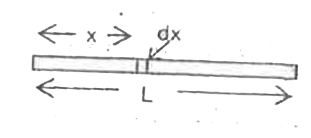
As rod is kept along x - axis
Hence, `Y_(cm)=0` and `Z_(cm)=0`
For x - coordinate
`x_(cm)=(int_(0)^(L)xdm)/(int_(0)^(L)dm)`
`dm=lambda dx = (A+Bx)dx`.
`x_(cm)=(int_(0)^(L)x(A+Bx)dx)/(int_(0)^(L)(A+Bx)dx)=((AL^(2))/(2)+(BL^(3))/(3))/(AL+(BL^(2))/(2))=(L(3A+2BL))/(3(2A+BL))`
Hence, coordinates of the centre of mass are `((L(3A+2BL))/(3(2A+BL)), theta, 0)`
Promotional Banner

Similar Questions

Explore conceptually related problems

A rod of length L is placed along the X-axis between x=0 and x=L . The linear density (mass/length) rho of the rod varies with the distance x from the origin as rho=a+bx. a.) Find the SI units of a and b b.) Find the mass of the rod in terms of a,b, and L.

The density of a thin rod of length l varies with the distance x from one end as rho=rho_0(x^2)/(l^2) . Find the position of centre of mass of rod.

Linear mass density of a rod AB(of length 10 m) varies with distance x from its end A as lambda = lambda_0x^3 ( lambda_0 is positive constant) . Distance of centre of mass of the rod , from end B is

A thin rod of length 6 m is lying along the x-axis with its ends at x=0 and x=6m. Its linear density *mass/length ) varies with x as kx^(4) . Find the position of centre of mass of rod in meters.

Linear mass density of a rod AB ( of length 10 m) varied with distance x from its end A as lambda = lambda_0 x^3 ( lamda_0 is poitive constant). Distance of centre of mass the rod, form end B is

A metal rod extends on the x- axis from x=0m to x=4m . Its linear density rho (mass // length) id not uniform and varies with the distance x from the origin according to equation rho=(1.5+2x)kg//m What is the mass of rod :-

A thin rod of length L is lying along the x-axis with its ends at x=0 and x=L its linear (mass/length) varies with x as k(x/L)^n , where n can be zero of any positive number. If to position x_(CM) of the centre of mass of the rod is plotted against 'n', which of the following graphs best apporximates the dependence of x_(CM) on n?

A mass m is at a distance a from one end of a uniform rod of length l and mass M. Find the gravitational force on the mass due to the rod.

A mass m is at a distance a from one end of a uniform rod of length l and mass M. Find the gravitational force on the mass due to tke rod.

The density of a non-uniform rod of length 1m is given by rho (x) = a (1 + bx^(2)) where a and b are constants and 0 le x le 1 . The centre of mass of the rod will be at

