Home
Class 12
PHYSICS
In the figure shown, initially the spri...

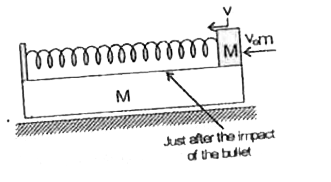
In the figure shown, initially the spring is in relaxed position. A bullet of mass m hits the block 'A' with horizontal speed `v_(0)` and gets embedded into it. Find the maximum compression in the spring. Stiffness of the spring is K. Neglect any friction and deformation in the spring during collision.

Text Solution

Verified by Experts
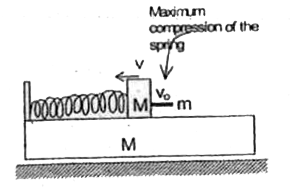
Since no external force is associated with the system `(M+M+m)` conservation of horizontal momentum of the system yields.
`mV_(0)=(M+m)v_(1)=(2M+m)v_(2)`
Where `v_(1)=` velocity of (M+m) just after the impact & `v_(2)=` velocity of (M+M+m) just of the maximum compression of the spring.
`rArr v_(1)=(mv_(0))/(M+m) & V_(2)=(mv_(0))/(2M+m)`
The loss of K.E. between the two portion (a) and (b) is given as,
`Delta KE=(1)/(2)(M+m)v_(1)^(2)-(1)/(2)(2M+m)v_(2)^(2)`

`rArr Delta KE=(m^(2)v_(0)^(2))/(2)[(1)/((M+m))-(1)/((2M+m))]=(m^(2)Mv_(0)^(2))/(2(M+m)(2M+m))`
From conservation of mechanical energy
`rArr (1)/(2)kx^(2)=(m^(2)Mv_(0)^(2))/(2(M+m)(2M+m))`
`rArr x = sqrt((m^(2)Mv_(0)^(2))/(2k(M+m)(2M+m)))=mv_(0)sqrt((M)/(2k(M+m)(2M+m)))`
Promotional Banner

Similar Questions

Explore conceptually related problems

A block of mass m moving with velocity v_(0) on a smooth horizontal surface hits the spring of constant k as shown. The maximum compression in spring is

A ball of mass m hits a wedge of mass M vertically with speed u , which is placed, on a smooth horizontal surface. Find the maximum compression in the spring, if the collision is perfectly elastic and no friction any where. Spring constant of spring is K .

A block of mass m is relesed from rest from a height h onto a smooth surface of mass M fitted with an ideal spring of stiffness k . find the maximum compression in the spring.

A bullet of mass m strikes a block of mass M connected to a light spring of stiffness k, with a speed v_(0) and gets into it. Find the loss of K.E. of the bullet.

The block of mass m is released when the spring was in its natrual length. Spring constant is k. Find the maximum elongation of the spring.

. In the figure shown, AB = BC = 2m . Friction coefficient everywhere is mu=0.2. Find the maximum compression of the spring.

A spring block pendulum is shown in figure . The system is hanging in equilibrium. A bullet of mass m//2 moving at a speed u bites the block from downwards direction and gets embedded in it. Find the amplitude of oscillation of the block now.

The figure shows two blocks of mass m each, connected by an ideal unstretched spring and then placed on a frictionless floor. If the blocks are given velocities v_(0) and 2v_(0) as shown, then the maximum extension in the spring is

A block of mass m is moving with an initial velocity v_0 towards a stationary spring of stiffness k attached to the wall as shown in figure a. Find the maximum compression in the spring. b. Is the work done by the spring negative or positive?

In figure, the stiffness of the spring is k and mass of the block is m . The pulley is fixed. Initially, the block m is held such that the elongation in the spring is zero and then released from rest. Find: a. the maximum elongation in the spring. b. the maximum speed of the block m . Neglect the mass of the spring and that of the string. Also neglect the friction.

