Home
Class 12
PHYSICS
A steel ball of mass 0.5 kg is fastened ...

A steel ball of mass `0.5 kg` is fastened to a cord `20 cm` long and fixed at the far end and is released when the cord is horizontal. At the bottom of its path the ball strikes a `2.5 kg` steel block initially at rest on a frictionless surface. The collision is elastic. The speed of the block just after the collision will be.

Text Solution

Verified by Experts
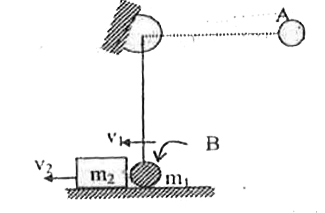
Let the ball strike the block with a speed `u_(1)`. Since the initial speed (speed before collision) of the block `= u_(2)=0` for the perfectly elastic collision, the speed of the block is given as
`v_(2)=(2m_(1))/(m_(1)+m_(2))u_(1)=(2(m_(1))/(m_(2)))/((m_(1))/(m_(2))+1)u_(1)`
where `u_(1)` can be found by conserving energy of the ball between the position A and B before collision of `m_(1)`.
`rArr (1)/(2)m_(1)u_(1)^(2)-m_(1)gl=0`
`rArr u_(1)=sqrt(2gl)=sqrt(2xx10xx20)=20` m/sec.
`(m_(1))/(m_(2))=(0.5 kg)/(2.5 kg) =(1)/(5)`
By putting `u_(1)=20` m/sec and `(m_(1))/(m_(2))=(1)/(5)` in (a) we obtain
`v_(2)={(2)/((1)/(5)+1)}{(1)/(5)}(20)=(20)/(3)m//s`
Promotional Banner

Similar Questions

Explore conceptually related problems

A buttle weighting 10 g and moving with a velocity 800 ms^(-1) strikes a 10 kg block resting on a frictionless surface. The speed of the block after the perfectly inelastic collision is approximately

A bullet weighing 10 g and moving with a velocity 300 m/s strikes a 5 kg block of ice and drop dead. The ice block is kept on smooth surface. The speed of the block after the the collision is

A glass ball collides with an identical ball at rest with v_(0)=2 m/sec. If the coefficient of restitution of collision is e = 0.5, find the velocities of the glass balls just after the collision.

Two balls each of mass 2kg (one at rest) undergo oblique collision is perfectly elastic, then the angle between their velocities after collision is

Two balls having masses m and 2m are fastened to two light strings of same length shown in the figure. The other ends of the strings are fixed at O. The strings are kept in the same horizontal line and the system is released from rest. The collision between the balls is elastic. (a). Find velocities of the balls just after their collision. (b). How high will the balls rise after the collision.

A ball moving on a horizontal frictionless plane hits an identical ball at rest with a velocity of 0.5m//s . If the collision is elastic, calculate the speed imparted to the target ball, if the speed of projectile after the collision is 30cm//s .

Three identical blocks A, B and C are placed on horizontal frictionless surface. The blocks B and C are at rest. But A is approaching towards B with a speed of 10 ms^(-1) The coefficient of restitution for all collision is 0.5. The speed of the block C just after collision is

Three identical blocks A, B and C are placed on horizontal frictionless surface. The blocks B and C are at rest. But A is approaching towards B with a speed of 10 ms^(-1) The coefficient of restitution for all collision is 0.5. The speed of the block C just after collision is

Two massless string of length 5 m hang from the ceiling very near to each other as shown in the figure. Two balls A and B of masses 0.25kg and 0.5kg are attached to the string. The ball A is released from rest at a height 0.45m as shown in the figure. The collision between two balls is completely elastic. Immediately after the collision, the kinetic energy of ball B is 1 J The velocity of ball A just after the collision is

A ball is projected on a very long floor. There may be two conditions (i) floor is smooth & (ii) the collision is elastic If both the considered then the path of ball is as follows. Now if collision is inelastic and surface is rough then the path is as follows. Successive range is decreasing . Roughness of surface decreases the horizontal component of ball during collision and inelastic nature of collision decreases the vertical component of velocity of ball. In first case both components remain unchanged in magnitude and in second case both the components of the velocity will change. Let us consider a third case here surface is rough but the collision of ball with floor is elastic. A ball is projected withe speed u at an angle 30^(@) with horizontal and it is known that after collision with the floor its speed becomes (u)/(sqrt(3)) . Then answer the following questions. If the ball after first collision with the floor has rebounded vertically then the speed of the ball just after the collision with the floor would have been :

