Home
Class 12
PHYSICS
Two identical balls each of mass m inter...

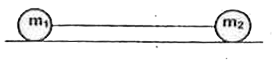
Two identical balls each of mass m interconnected by a small light inextensible string are kept on a smooth horizontal surface. One of the balls is pushed towards the other with a speed `v_(0)` find the loss of K.E. of the ball. What will be the final velocities of the balls ? (e=1).

Text Solution

Verified by Experts

We know that, when two identical bodies collide elastically, they transfer their momenta. That means, Just after collision the stationary ball starts moving with a speed `v_(0)` and the first ball will be stationary. The second ball will continue moving with speed, say, v. Since no external force is acting on the system of the balls and string (tension in the string is internal force), the system conserves its linear momentum. Conserving the momentum of the system just before and after the string taul obtain.
`mv_(0)=mv+mv`
`rArr v=(v_(0))/(2)`
(a) Now the loss in K.E. of the ball
`Delta KE=(1)/(2)m v^(2)+(1)/(2)mv^(2)-(1)/(2)mv_(0)^(2)`
Putting `v=(v_(0))/(2)`, value of `Delta KE` can be found.
Promotional Banner

Similar Questions

Explore conceptually related problems

Two identical small balls, each of mass m , are connected by a massless and inextensible string of length l and placed on a smooth horizontal xy plane. An external agent pulling the string from its mid-point along y -axis with velocity v_(0) as shown in Fig. When the separation between the two balls reduces to l//2 then the speed of each ball will be

Two identical balls, each of mass m , are tied with a string and kept on a frictionless surface. Initially, the string is slack. They are given velocities 2u and u . in the same direction. Collision between the balls is perfectly elastic. What is the final loss in kinetic energy of the balls?

Two smooth balls of mass m_1 and m_2 connected by a light inextensible string are at the opposite points of horizontal diameter of a smooth semi cylindrical surface of radius R. If m_1 is released, find its speed at any angular distance theta moved by m_2 .

Three identical balls are connected by light inextensible strings with each other as shown and rest over a smooth horizontal table. Length of each string is l . At moment t = 0 , ball B is imparted a velocity v_(0) perpendicular to the strings and then the system is left on its own. If collision between the balls is completely inelastic, then

Three identical balls are connected by light inextensible strings with each other as shown and rest over a smooth horizontal table. Length of each string is l . At moment t = 0 , ball B is imparted a velocity v_(0) perpendicular to the strings and then the system is left on its own. Calculate the velocity of A at the above given instant.

Two identical balls, each of mass m , are tied with a string and kept on a frictionless surface. Initially, the string is slack. They are given velocities 2u and u . in the same direction. Collision between the balls is perfectly elastic. After the first collision, what is the total loss in kinetic energy of the balls?

Two balls of masses m_(1)=5kg, m_(2)=10kg are connected by a light inextensible string. A horizontal force F = 15 N is acting on the ball m_(2) along the line joining two balls as shown. What is the (a) acceleration of the balls (b) tension in the string?

Three identical balls are connected by light inextensible strings with each other as shown and rest over a smooth horizontal table. Length of each string is l . At moment t = 0 , ball B is imparted a velocity v_(0) perpendicular to the strings and then the system is left on its own. Calculate the velocity of B just before A collides with ball C .

Two small balls A and B, each of mass m, are joined rigidly at the ends of a light rof of length L. they are placed on a frictionless horizontal surface another ball of mass 2 m moving with speed u towards one of the ball and perpendicular to the length of the rod on the horizontal frictionless surface as shown int he figure. if the coefficient of restitution is 1/2 then the angular speed of the rod after the collision will be

In fig. a ball of mass m_(1) and a block of mass m_(2) are joined together with an inextensible string. The ball can slide on a smooth horizontal surface. If v_(1) and v_(2) are the respective speeds of the ball and the block, then determine the constraint relation between the two.
