Home
Class 12
PHYSICS
A uniform circular disc of mass 2 m and ...

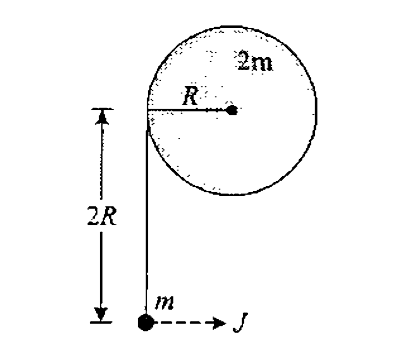
A uniform circular disc of mass 2 m and radius R placed freely on a horizontal smooth surface as shown in the figure- 5.116.A particle of mass m is connected to the circumference of the disc with a massless string. Now an impulse J is applied on the particle in the directions shown by dotted line. The acceleration of centre of mass of the disc just after application of implues is `("If J "= 10 N -sec ., m=sqrt10 kg and R= 25cm )`

A

`1 m//s^(2)`

B

`2m//s^(2)`

C

`3 m//s^(2)`

D

`4m//s^(2)`

Text Solution

Verified by Experts

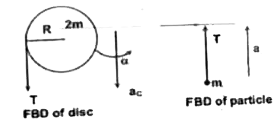
`T=2ma_(c )` …(i)
`RT_(1)=(2mR^(2))/(2)alpha` …(ii)
`T+m(a_(c )+alpha R)=(mJ^(2))/(m^(2)2R)`
`T+(T)/(2)+T=(J^(2))/(2mR)`
`therefore (5T)/(2)=(J^(2))/(2mR)`
`T=(J^(2))/(5mR)`
`a_(c )=(T)/(2m)=(J^(2))/(5mR2m)=(J^(2))/(10m^(2)R)`
putting all the values `a_(c )=4 m//s^(2)`
Promotional Banner

Similar Questions

Explore conceptually related problems

A uniform circular ring of mass m and radius R is placed freely on a horizontal smooth surface as shown in figure. A particle of mass m is connected to the circumference of the ring with massless string . The particle is imparted velocity v_0 perpendicular to length of string as shown. If T is tension in the string just after the particle imparted velocity , then Acceleration of point P at this instant , is

What will be the position of centre of mass of a half disc shown ? .

A uniform disc of mass M and radius R is liffted using a string as shown in the figure. Then choose incorrect option(s),

A disc of mass M and radius R rolls on a horizontal surface and then rolls up an inclined plane as shown in the figure. If the velocity of the disc is v, the height to which the disc will rise will be:

A uniform circular disc of mass m is set rolling on a smooth horizontal table with a uniform linear velocity v. Find the total K.E. of the disc.

A uniform circular disc of radius R is placed on a smooth horizontal surface with its plane horizontal and hinged at circumference through point O as shown . An impulse P is applied at a perpendicular distance h from its centre C. The value of h so that the impulse due to hinge is zero, is

A disc of mass M and radius R moves in the x-y plane as shown in the figure. The angular momentum of the disc at tihe instant shows is

A particle of mass m is doing horizontal circular motion with the help of a string (conical pendulum) as shown in the figure. If speed of the particle is constant then,

A disc of mass m and radius R is kept on a smooth horizontal surface with its plane parallel to the surface. A particle of same mass m travelling with speed v_(0) collides with the stationery disc and gets embedded into it as shown in the figure. Then

A uniform circular disc of mass M and radius R is pivoted at distance x above the centre of mass of the disc, such that the time period of the disc in the vertical plane is infinite. What is the distance between the pivoted point and centre of mass of the disc ?