Home
Class 12
PHYSICS
Five identical balls each of mass m and ...

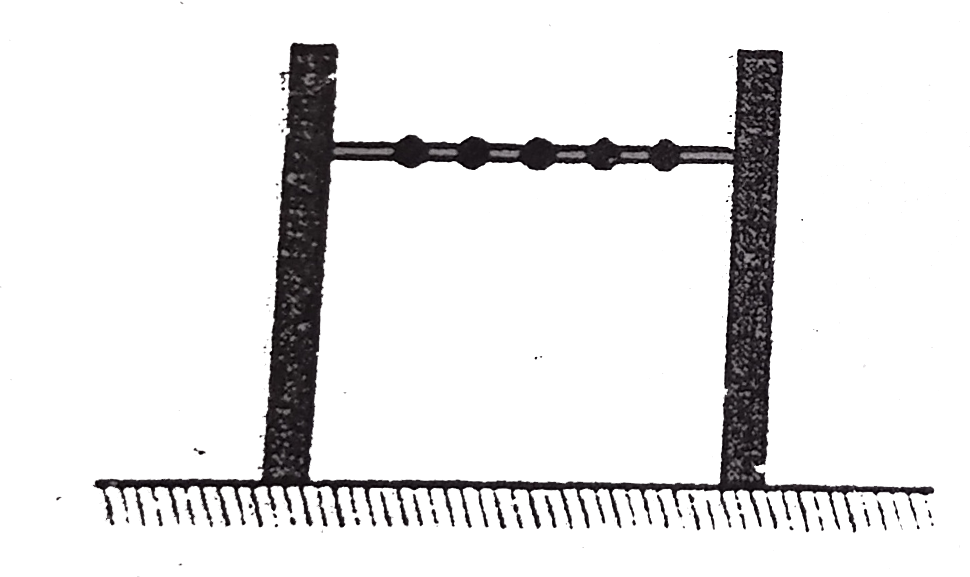
Five identical balls each of mass m and radius r are string like beads at random and at rest along a smooth rigid horizontal thin rod of length L mounted between immovable supports Assume `10rleL` and that the collision between balls or between balls and supports are elastic if one ball is struck horizontally so as to acquire a speed v the average force felt by the support is

A

`(5mv^(2))/(L-5r)`

B

`(mv^(2))/(L-10r)`

C

`(5mv^(2))/(L-10r)`

D

`(mv^(2))/(L-5r)`

Text Solution

Verified by Experts

`lt F gt = (2mv xx 6v)/(12(L-10r))=(mv^(2))/(L-10r)`
Promotional Banner

Similar Questions

Explore conceptually related problems

Two identical balls, each of mass m , are tied with a string and kept on a frictionless surface. Initially, the string is slack. They are given velocities 2u and u . in the same direction. Collision between the balls is perfectly elastic. What is the final loss in kinetic energy of the balls?

Two identical balls each of mass m interconnected by a small light inextensible string are kept on a smooth horizontal surface. One of the balls is pushed towards the other with a speed v_(0) find the loss of K.E. of the ball. What will be the final velocities of the balls ? (e=1).

Two identical balls, each of mass m , are tied with a string and kept on a frictionless surface. Initially, the string is slack. They are given velocities 2u and u . in the same direction. Collision between the balls is perfectly elastic. After the first collision, what is the total loss in kinetic energy of the balls?

Two identical balls, each of mass m , are tied with a string and kept on a frictionless surface. Initially, the string is slack. They are given velocities 2u and u . in the same direction. Collision between the balls is perfectly elastic. What is the impulse generated in the string during the first collision?

A bead of mass m and diameter d is sliding back and forth with velocity v on a wire held between two right walls of length L. Assume that th ecollisions with the wall are perfectly elastic and ther is no friction. The average force that the bouncing bead exerts on the one of the walls is :_

Three identical balls are connected by light inextensible strings with each other as shown and rest over a smooth horizontal table. Length of each string is l . At moment t = 0 , ball B is imparted a velocity v_(0) perpendicular to the strings and then the system is left on its own. If collision between the balls is completely inelastic, then

Two smooth balls A and B, each of mass m and radius R, have their centers at (0, 0, R) and at (5R, -R, R) respectively, in a coordinate system as shown. Ball A, moving along positive x axis, collides with ball B. Just before the collision, speed of ball A is 4m/s and ball B is stationary. The collision between the ball is elastic. Impulse of the force exerted by A and B during the collision, is equal to

A ball of mass 'm' is thrown with a speed v_0 towards a bat. It rebounds along the same speed 2v_0 . The variation of interaction force between the bat and ball is shown Average force exerted by the bat on the ball is

Three balls A, B and C are placed on a smooth horizontal surface. Given that m_A=m_C=4m_B . Ball B collides with ball C with an initial velocity v as shown in figure. Find the total number of collisions between the balls. All collisions are elastic.

Two identical small balls, each of mass m , are connected by a massless and inextensible string of length l and placed on a smooth horizontal xy plane. An external agent pulling the string from its mid-point along y -axis with velocity v_(0) as shown in Fig. When the separation between the two balls reduces to l//2 then the speed of each ball will be

