Home
Class 12
PHYSICS
Two smooth balls A and B, each of mass m...

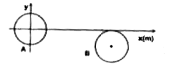
Two smooth balls A and B, each of mass m and radius R, have their centers at (0, 0, R) and at (5R, -R, R) respectively, in a coordinate system as shown. Ball A, moving along positive x axis, collides with ball B. Just before the collision, speed of ball A is 4m/s and ball B is stationary. The collision between the ball is elastic.

Impulse of the force exerted by A and B during the collision, is equal to

A

`(sqrt(3)mi+3mj)kg-m//s`

B

`((sqrt(3))/(2)mi-sqrt(3)mj)kg-m//s`

C

`(3mi-sqrt(3)mj)kg-m//s`

D

`(2sqrt(3)mi+3mj)kg-m//s`

Text Solution

Verified by Experts

The correct Answer is:

C

`vec(J)_(A on B) = m vec(v)_(B_(f))-vec(v)_(B_(i))`
`= m [4cos 30^(@)(cos 30 hat(i)-sin 30^(@)hat(j))-0]`
`= (2 mi - sqrt(3)mj kg - m//s)`
`therefore` (C )
Promotional Banner

Similar Questions

Explore conceptually related problems

Two smooth balls A and B, each of mass m and radius R, have their centre at (0,0,R) and (5R,-R,R) respectively, in a coordinate system as shown. Ball A, moving along positive x-axis, collides with ball B. Just before the collision, speed of ball A is 4m/s and ball B is stationary. The collision between the balls is elastic. Velocity of the ball A just after the collsion is A. (hati+sqrt3hatj)m//s B. (hati-sqrt3hatj)m//s C. (2hat(i) + sqrt3hat(j)) m//s D. (2hati+2hatj)m//s

A ball A moving with momentum 2hati + 4hatj collides with identical ball B moving with momentum 6hatj . After collision momentum of ball B is 10 hatj . Which of the following statement is correct?

A highly elastic ball moving at a speed of 3 m//s approaches a wall moving towards it with a speed of 3 m//s . After the collision. the speed of the ball will be

The figure below shows three identical balls A , B and C. Initially , the baiis B and C are at rest and the ball A while moving with a veiocity v, collides with ball B. if the collision is perfectiy elastic , then after the collision

Velocity of the ball A after collision with the ball B as shown in the figure is (Assume perfectly inelastic and head - on collision)

An iron ball A collides with another stationary iron ball B If the ratio of radii of the balls is n = 2, find the ratio of their speeds just after the collision (e = 0.5)

A ball weighing 4 kg and moving with velocity of 8 m/sec. Collides with a stationary ball of mass 12 kg. After the collision, the two balls move together. The final velocity is

Three balls A, B and C of same mass m are placed on a frictionless horizontal plane in a straight line as shown. Ball A is moved with velocity u towards the middle ball B . If all the collisions are elastic, find the final velocities of all the balls.

A ball A of mass M collides elastically with a similar ball B at rest as shown in figure. Initially velocity of ball A is u m/s. After collision,

A ball of mass 1 kg strikes a heavy plarform elastically, moving upwards with a velocity of 5 m//s . The speed of the ball just before the collision is 10 m//s downwards. Then the impulse imparted by the platform on the ball is
