Home
Class 12
PHYSICS
Two blocks of masses 2kg and M are at re...

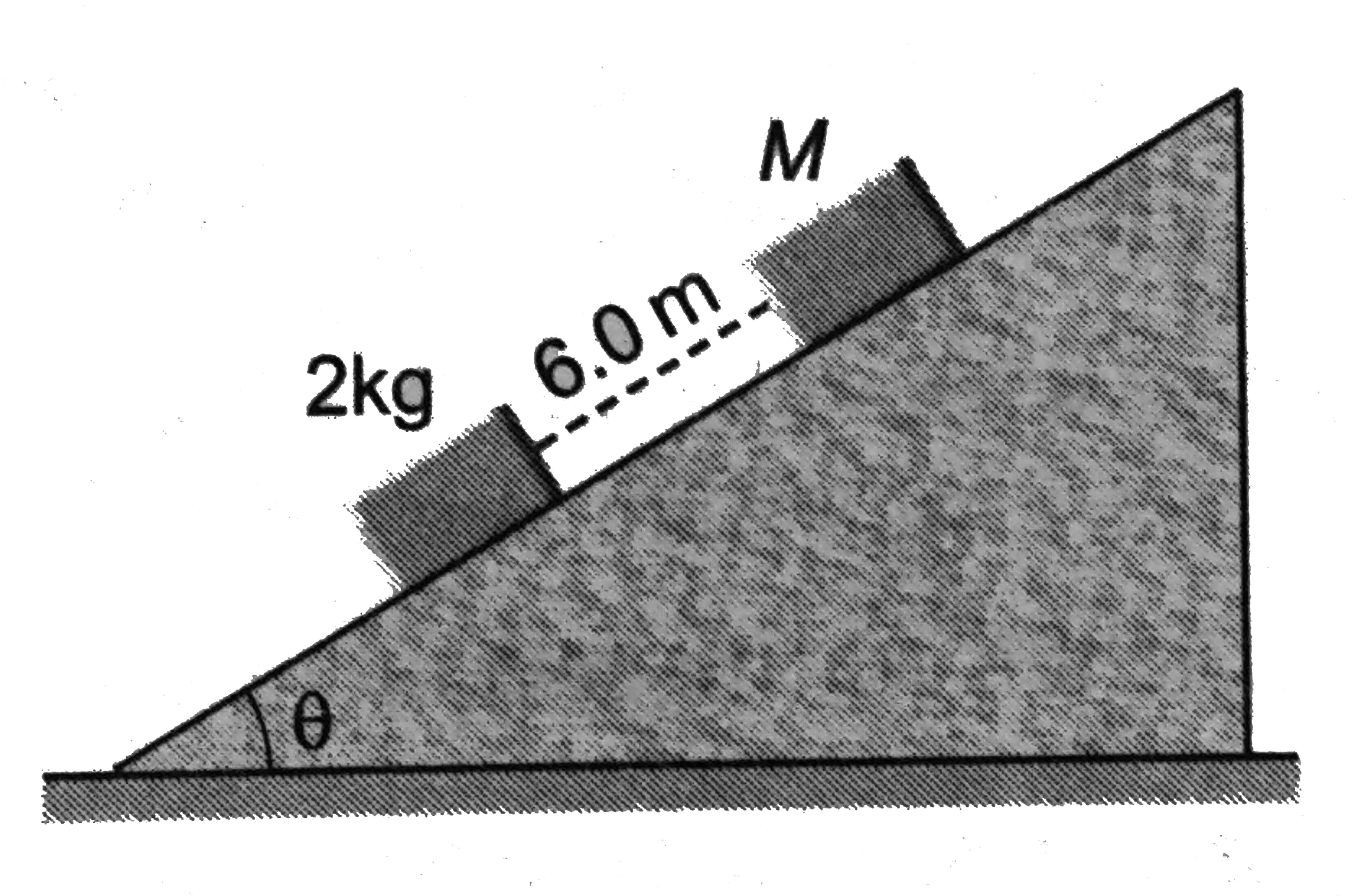
Two blocks of masses `2kg` and M are at rest on an inclined plane and are separated by a distance of `6.0m` as shown. The coefficient of friction between each block and the inclined plane is `0.25`. The `2kg` block is given a velocity of `10.0m//s` up the inclined plane. It collides with M, comes back and has a velocity of `1.0m//s` when it reaches its initial position. The other block M after the collision moves `0.5m` up and comes to rest. Calculate the coefficient of restitution between the blocks and the mass of the block M.
[Take `sintheta=tantheta=0.05` and `g=10m//s^2`]

Text Solution

Verified by Experts
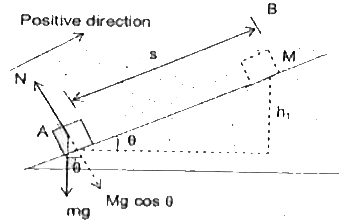
For the block of mass 2 kg (=m) in going from the A to B
`(KE+PE)_("initial")=(KE+PE)_("final")+W_("friction")`
`(1)/(2)mv_(1)^(2)+0=(1)/(2)mv_(f)^(2)+mgh_(1)+F_(f)s`
of `v_(f)^(2)=2[(1)/(2)v_(l)^(2)-gh_(1)-mu gs]`
Substituting the given data, we get
`v_(f)^(2)=2[(1)/(2)(10.0 m//s^(2))-(10m//s^(2))(0.30m)-(0.25)(10m//s^(2))(6.0m)]`
Or, `v_(f)=8 m//s`
For the block of mass 2 kg (=m) coming back from the position B to A
`(KE+PE)_("initial")=(KE+PE)_("final")+W_("friction")`
`(1)/(2)mu_(l)^(2)+mgh_(1)=(1)/(2)mu_(f)^(2)+0+F_(f)s`
`u_(l)^(2)=2[(1)/(2)u_(f)^(2)+ mu gs-gh_(l)]`
Substituting the given data, we get
`u_(l)^(2)=2[(1)/(2)(-1.0m//s^(2))+(0.25)(10 m//s^(2))(6.0m)-(10m//s^(2))(0.30m)]`
Or `u_(l)=-5.0 m//s`

For the block of Mass M in going from the position B to C
`(KE+PE)_("initial")=(KE+PE)_("final")+W_("friction")`
`(1)/(2)Mc_(1)^(2)+Mgh_(1)=(1)/(2)Mc_(r )^(2)+Mg(h_(1)+h_(2))+F_(f)S_(2)`
or `(1)/(2)c_(1)^(2)=(1)/(2)c_(1)^(2)+gh_(2)+mu gs_(2)`
`(1)/(2)c_(i)^(2)=(1)/(2)(0)+(10 m//s^(2))(0.25 m)+(0.25)(10 m//s^(2))(0.5m)`
`c_(i)=sqrt(3)m//s`
`e=(u_(i)-c_(i))/(v_(f)-c_(i))=((-5.0m//s)-(-sqrt(3)m//s))/((8.0 m//s)-0)=(5+sqrt(3))/(8)=0.84`
Promotional Banner

Similar Questions

Explore conceptually related problems

A block of mass 3 kg rests on a rough inclined plane making an angle of 30^(@) . With the horizontal. The coefficient of static friction between the block and the plane is 0.7. The frictional force on the block is

A block of mass 2kg rests on a rough inclined plane making an angle of 30^@ with the horizontal. The coefficient of static friction between the block and the plane is 0.7. The frictional force on the block is

A block of mass 2kg rests on a rough inclined plane making an angle of 30^@ with the horizontal. The coefficient of static friction between the block and the plane is 0.7. The frictional force on the block is

A block of mass m is placed at rest on an inclination theta to the horizontal. If the coefficient of friction between the block and the plane is mu , then the total force the inclined plane exerts on the block is

A block sliding down a rough 45° inclined plane has half the velocity it would have had, the inclined plane been smooth. The coefficient of sliding friction between block and the inclined plane is

Two blocks each of mass M are resting on a frictionless inclined plane as shown in fig then:

Find the force required to pull a block of mass 100kg up an incline of 8^(@) at a uniform speed of 5m//s . The coefficient of friction between the block and the plane is 0.3 .

A block of mass m slides down an inclined plane of inclination theta with uniform speed. The coefficient of friction between the block and the plane is mu . The contact force between the block and the plane is

A block of mass m is at rest on a rough inclined plane of angle of inclination theta . If coefficient of friction between the block and the inclined plane is mu , then the minimum value of force along the plane required to move the block on the plane is

A block of mass 2 kg slides down an incline plane of inclination 30°. The coefficient of friction between block and plane is 0.5. The contact force between block and plank is :