Home
Class 12
PHYSICS
Two bodies A and B of masses m and 2m r...

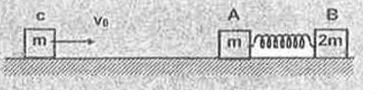
Two bodies A and B of masses m and 2m respectively are placed on a smooth floor. They are connected by a light spring of stiffness k.
A third body C of mass m moves with velocity `v_(0)` along the line joining A and B and collides elastically with A. If `l_(o)` be the natural length of the spring then find the minimum separation between the blocks.

Text Solution

Verified by Experts

Initially there will be collision between C and A which is elastic, therefore by using conservation of momentum we obtain,
`mv_(0)=mv_(A)+mv_(c ), " " v_(0)=v_(A)+v_(C )`
Since `e=1, v_(0)=v_(A)-v_(C )`
Solving the above two equations, `v_(A)=v_(0)` and `v_(c )=0`.
Now A will move and compress the spring which in turn accelerate B and retard A and finally. both A and B will move with same velocity v.
(a) Since net external force is zero, therefore momentum of the system (A and B) is conserved.
`rArr v=v_(0)//3`
(b) If `x_(0)` is the maximum compression, then using energy conservation
`(1)/(2)mv_(0)^(2)=(1)/(2)(m+2m)v^(2)+(1)/(2)kx_(0)^(2)`
`rArr (1)/(2)mv_(0)^(2)=(1)/(2)(3m)(v_(0)^(2))/(9)+(1)/(2)kx_(0)^(2)`
`rArr x_(0)=v_(0)sqrt((2m)/(3k))`
Hence minimum distance `D=l_(0)=x_(0)==l_(0)-v_(0)sqrt((2m)/(3k))`
Promotional Banner

Similar Questions

Explore conceptually related problems

Two blocks A and B of masses in and 2m respectively placed on a smooth floor are connected by a spring. A third body C of mass m moves with velocity v_(0) along the line joining A and B and collides elastically with A . At a certain instant of time after collision it is found that the instantaneous velocities of A and B are same then:

Two blocks A and B of masses m and 2m respectively are placed on a smooth floor. They are connected by a spring. A third block C of mass m moves with a velocity v_0 along the line joing A and B and collides elastically with A, as shown in figure. At a certain instant of time t_0 after collision, it is found that the instantaneous velocities of A and B are the same. Further, at this instant the compression of the spring is found to be x_0 . Determine (i) the common velocity of A and B at time t_0 , and (ii) the spring constant.

Two identical blocks A and B , each of mass m resting on smooth floor are connected by a light spring of natural length L and spring constant k , with the spring at its natural length. A third identical block C (mass m ) moving with a speed v along the line joining A and B collides with A . The maximum compression in the spring is

Two blocks A and B of mass m and 2m respectively are connected by a light spring of force constant k. They are placed on a smooth horizontal surface. Spring is stretched by a length x and then released. Find the relative velocity of the blocks when the spring comes to its natural length

Two blocks A and B of mass 2m and m respectively are connected to a massless spring of force constant K as shown in figure A and B are moving on the horizontal frcitionless surface with velocity v to right with underformed spring. If B collides with C elastically, then maximum compression of the spring will be

A body of mass m/2 moving with velocity v_0 collides elastically with another mass of m/3 . Find % change in KE of first body

Two blocks A and B of mass 2 m and m respectively are connected to a massless spring of spring constant K. if A and B moving on the horizontal frictionless surface with velocity v to right. If A collides with C of mass m elastically and head on, then the maximum compressions of the spring will be

A body of mass m moving with velocity u hati collides elastically with a body at rest of mass 3m and then the final velocity of body mass m is v hatj . Find the relation between v and u

A bullet of mass m strikes a block of mass M connected to a light spring of stiffness k, with a speed v_(0) and gets into it. Find the loss of K.E. of the bullet.

Two blocks A and B of masses in and 2m , respectively, are connected with the help of a spring having spring constant, k as shown in Fig. Initially, both the blocks arc moving with same velocity v on a smooth horizontal plane with the spring in its natural length. During their course of motion, block B makes an inelastic collision with block C of mass m which is initially at rest. The coefficient of restitution for the collision is 1//2 . The maximum compression in the spring is
