Home
Class 12
PHYSICS
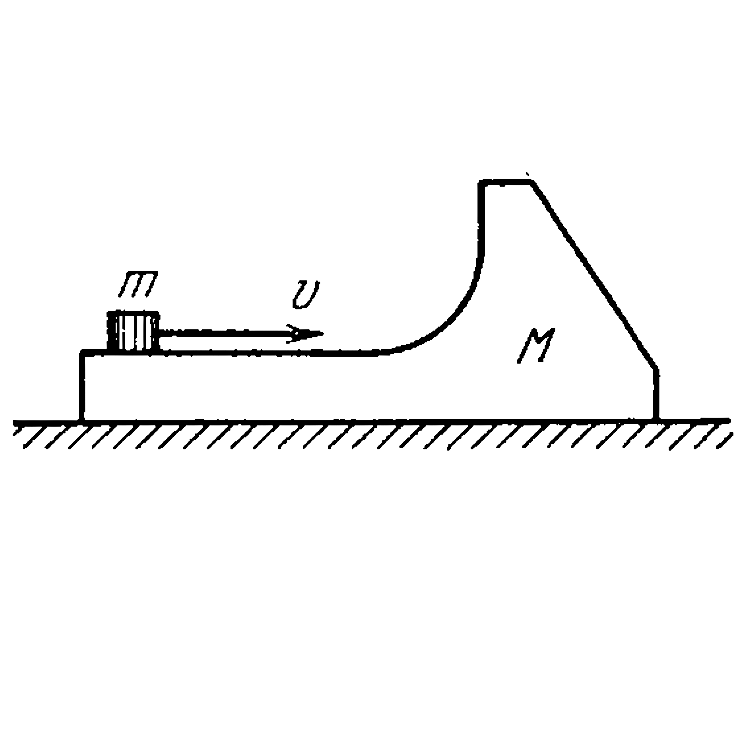
A body of mass M (figure) with a small d...

A body of mass M (figure) with a small disc of mass m placed on it rests on a smooth horizontal plane. The disc is set in motion in the horizontal direction with velocity v. To what height (relative to the initial level) will the disc rise after breaking off the body M? The friction is assumed to be absent.

Text Solution

Verified by Experts

The correct Answer is:

`(Mv^(2))/(2g(M+m))`
Promotional Banner

Similar Questions

Explore conceptually related problems

A block of mass m is placed at rest on a smooth wedge of mass M placed at rest on a smooth horizontal surface. As the system is released

At t=0 , a force F=at^(2) is applied to a small body of mass m at an angle alpha resting on a smooth horizontal plane

A smooth wedge of mass M rests on a smooth horizontal surface. A block of mass m is projected from its lowermost point with velocity v_(0) . What is the maximum height reached by the block?

A smooth wedge of mass M rests on a smooth horizontal surface. A block of mass m is projected from its lowermost point with velocity v_(0) . What is the maximum height reached by the block?

A point mass m collides with a disc of mass m and radius R resting on a rough horizontal surface as shown . Its collision is perfectly elastic. Find angular velocity of the disc after pure rolling starts

A disc of mass M and radius R rolls on a horizontal surface and then rolls up an inclined plane as shown in the figure. If the velocity of the disc is v, the height to which the disc will rise will be:

A uniform circular disc of mass m is set rolling on a smooth horizontal table with a uniform linear velocity v. Find the total K.E. of the disc.

A force F acts tangentially at the highest point of a disc of mass m kept on a rough horizontal plane. If the disc rolls without slipping, the acceleration of centre of the disc is:

Two small discs of masses m_(1) and m_(2) are connected by a weightless spring resting on a smooth horizontal plance. The discs are set in motion with initial velocities v_(1) and v_(2) whose directions are mutually perpendicular and in the same horizontal plane. Find the total energy E of hte system with reference to the frame fixed to the centre of mass.

A disc of mass M and Radius R is rolling with an angular speed omega on the horizontal plane. The magnitude of angular momentum of the disc about origin is:
