Home
Class 12
PHYSICS
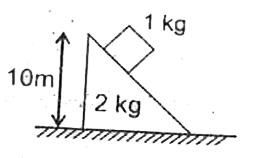
A block of mass 1 kg is released from th...

A block of mass 1 kg is released from the top of a wedge of mass 2 kg. Height of wedge is 10 meter and all the surfaces are frictionless. Then

A

Displacement of centre of mass of system in vertical direction is zero.

B

Displacement of centre of mass of system, vertically downwards, is `(10)/(3)m`,

C

Ration of normal reaction between block and wedge to the acceleration of wedge w.r.t ground is 4 (in kg).

D

Momentum of system will not be conserved in horizontal direction.

Text Solution

Verified by Experts

The correct Answer is:

B
Promotional Banner

Similar Questions

Explore conceptually related problems

A block of mass M is placed on the top of a bigger block of mass 10 M as shown in figure. All the surfaces are frictionless. The system is released from rest, then the distance moved by the bigger block at the instant the smaller block reaches the ground :

A block of mass 'M' is placed on the top of a wedge of mass '4M'. All the surfaces are frictionless. The system is released from rest. The distance moved by the wedge at the instant, the block reaches the bottom will be

A block of mass m is released from the top of a wedge of mass M as shown in figure. Find the displacement of wedges on the horizontal ground when the block reaches the bottom of the wedges. Neglect friction everywhere.

A small ball ( uniform solid sphere ) of mass m is released from the top of a wedge of the same mass m . The wedge is free to move on a smooth horizontal surface. The ball rolld without sliding on the wedge. The required height of the wedge are mentioned in the figure. The total kinetic energy of the ball just before it falls on the ground

A small ball ( uniform solid sphere ) of mass m is released from the top of a wedge of the same mass m . The wedge is free to move on a smooth horizontal surface. The ball rolld without sliding on the wedge. The required height of the wedge are mentioned in the figure. The speed of the wedge when the ball is just going to leave the wedge at point 'P' of the wedge is

A block of mass m is placed on the top of bigger wedge M . All the surfaces are frictionless. The system is released from rest. Find the distance moved by smaller block (w.r.t. triangular wedge) when bigger wedge travel distance X on plane surface

A block of mass 2kg slides down the face of a smooth 45^@ wedge of mass 9 kg as shown in the figure. The wedge is placed on a frictionless horizontal surface. Determine the acceleration of the wedge.

A block of mass m is released from a wedge of mass m as shown in figure . Find the time taken by the block to reach the end of the wedge.

A particle mass m = 0.1 kg is released from rest from a point A of a wedge of mass M = 2.4 kg free to slide on a frictionless horizontal plane. The particle slides down the smooth face Ab of the wedge. When the velocity of th ewedge is 0.2 m//s the particle in m//s relative to the wedge is :-

A block of mass m is pushed towards a movable wedge of mass nm and height h , with a velocity u . All surfaces are smooth. The minimum value of u for which the block will reach the top of the wedge is
