Home
Class 12
PHYSICS
A pulley fixed to the ceiling of an elev...

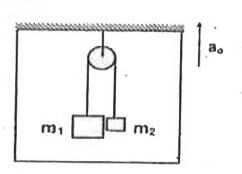
A pulley fixed to the ceiling of an elevator car carries a thread whose ends are attached to the masses `m_(1) and m_(2)`. The car starts going up with an acceleration `a_(0)`. Assuming the masses of the pulley and the thread as well as the friction to be negligible, find:

(a) the acceleration of the load `m_(1)` relative to the elevator shaft and relative to the car
(b) the force exerted by the pulley on the ceiling of the car. Given `m_(1) gt m_(2)`.

Text Solution

Verified by Experts
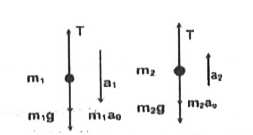

(a) The elevator is an accelerated frame which is non-inertial, pseudo force `m_(1)a_(0) lt m_(2)a_(0)` have been taken into consideration for `m_(1) and m_(2)`, respectively.
`m_(1)g+m_(1)a_(0)-T=m_(1)a_(1)" "...(i)`
`T-m_(2)g-m_(2)a_(0)=m_(2)a_(2)" " ...(ii)`
`a_(1)=a_(2)" "...(iii)`
Solving the above equations, we get,
`a_(1)=((m_(1)-m_(2)).(a_(0)+g))/((m_(1)+m_(2)))`
This is the acceleration of `m_(1)` w.r.t., car.
(b) Acceleration of the mass `m_(1)` w.r.t. the elevator shaft `=a_(0)-a_(1)`
`=(2a_(0)m_(2)-g(m_(1)-m_(2)))/((m_(1)+m_(2)))`
Force exerted by the pulley on the ceiling of the car
`=2.T=(m_(1)a_(0) +m g-m_(1)a_(1))xx2=(4m_(1)m_(2)(a_(0)+g))/((m_(1)+m_(2)))`
Promotional Banner

Similar Questions

Explore conceptually related problems

A pulley fixed to the ceiling carried a thread with bodies of masses m_(1) and m_(2) attached to its ends. The mases of the pulley and the thread are negligible and friction is absent. Find the acceleration of the centre of mass of this system.

Two bodies with masses m_1 and m_2(m_1gtm_2) are joined by a string passing over fixed pulley. Assume masses of the pulley and thread negligible. Then the acceleration of the centre of mass of the system (m_1+m_2) is

A block of mass m is arranged on the wedge as shown in figure . The wedge angle is theta . If the masses of pulley and thread and negligible and friction is absent , find the acceleration of the wedge

In the arrangement shown in figure the masses of the wedge M and the body m are known. The appreciable friction exists only between the wedge and the body m , the friction coefficient being equal to k . The masses of the pulley and the thread are negligible. Find the acceleration of the body m relative to the horizontal surface on which the wedge slides.

(1) Find the acceleration of centre of mass of the system shown. (ii) Find the normal reaction applied by the pulley on the thread.

Find the acceleration of the body of mass m_(2) in the arrangement shown in figure. If the mass m_(2) is eta time the mass m_(1) and the angle that the inclined plane forms with the horizontal is equal to theta . The masses of the pulley and threads, as well as the friction, are assumed to be negligible.

If the pulley is massles and moves with an upward acceleration a_(0) . Find the acceleration of (m_1)and (m_2) w.r.t to elevator.

A pulley is connected to the ceiling of an elevator by a massless rod. Two masses are connected as shown in figure. There is sufficient friction in the pulley axis. The acceleration of block w.r.t. earth is

In the arrangement shown in the figure the elevator is going up with an acceleration of g/10. If the pulley and the string are light and the pulley is smooth, the tension in the string AB is

A pulley is attached to the celing of a lift moing upwards. Two particles are attached to the two ends of a stirng passing over the pulley. The masses of the particles are in the ration 2:1 if the acceleration of the particles is g/2, then the acceleration of the lift will be

