Home
Class 12
PHYSICS
In the figure masses m(1),m(2) and M are...

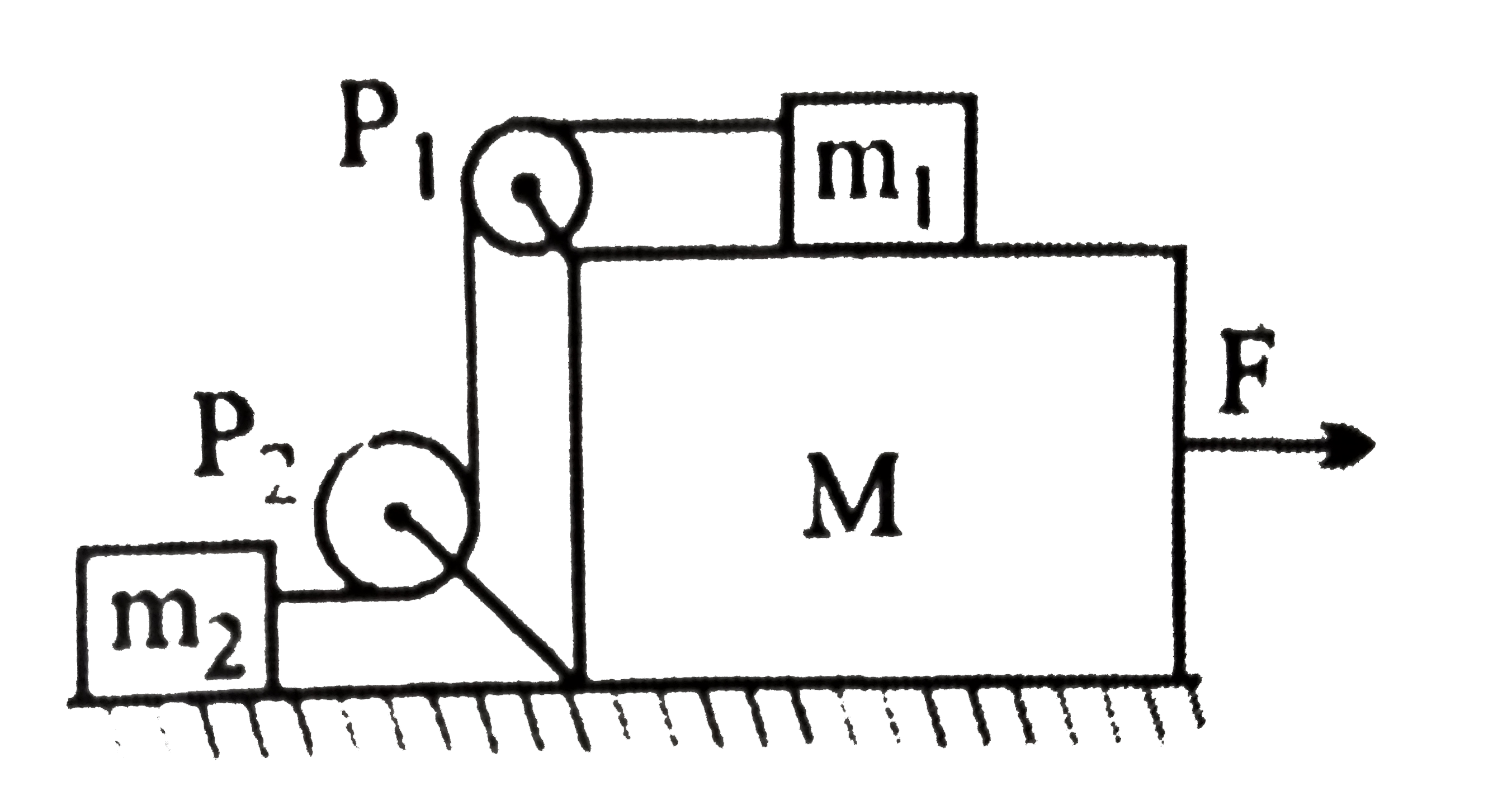
In the figure masses `m_(1),m_(2)` and M are kg. 20 Kg, 5 kg and 50 kg respectively. The co-efficient of friction between M and ground is zero. The co-efficient of friction between `m_(1)` and M and that between `m_(2)` and ground is `0.3.` The pulleys and the string are massless. The string is perfectly horizontal between `P_(1) and m_(1)` and also between `P_(2) and m_(2).` The string is perfectly verticle between `P_(1) and P_(2).` An externam horizontal force F is applied to the mass M. Take `g=10m//s^(2).`

(i) Drew a free-body diagram for mass M, clearly showing all the forces.
(ii) Let the magnitude of the force of friction between `m_(1)` and M be `f_(1)` and that between `m,_(2)` and ground be `f_(2).` For a particular F it is found that `f_(1)=2f_(2).` Find `f_(1) and f_(2).` Write down equations of motion of all the masses. Find F, tension in the string and accelerations of the masses.

Text Solution

Verified by Experts
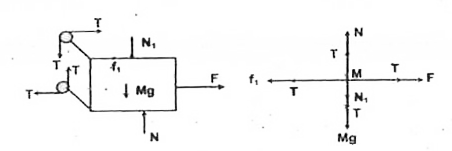
(a)
(b) We consider the following cases:
(i) All the three blocks are moving and `m_(1)` moves relative to M.
In this case,
`(f_(1))_("max")= mu_(1)N_(1)=mu_(1)m_(1)g=0.3 xx 20xx10=60N`
`(f_(2))_("max")=mu_(2)m_(2)g=0.3xx5xx10=15N`
Given that `f_(1)=2f_(2)" or " f_(2)=f_(1)//2`
The maximum value of `f_(2)` is 15N so `f_(1)` cannot be more than 30N. This case is not possible. So, `m_(1)` remain at rest w.r.t. M.
(ii) All three blocks are at rest.
Now, `F-f_(1)=0, T=f_(1) and T=f_(2)`
So, `f_(1)=f_(2)" " ` (not possible)
(iii) All the three blocks are moving with same acceleration .a..
In this case,
Equation for `M:F-f_(1)=Ma`
Equation for `m_(1):f_(1)-T=m_(1)a`
Equation for `m_(2):T-f_(2)=m_(2)a`
`f_(1)=2f_(2)=15xx2`
Solving, we get `a=0.6m//s^(2), F=60N, T=18N, f_(2)=15N, f_(1)=30N`.
Promotional Banner

Similar Questions

Explore conceptually related problems

In the figure masses m_1 , m_2 and M are 20 kg, 5kg and 50kg respectively. The coefficient of friction between M and ground is zero. The coefficient of friction between m_1 and M and that between m_2 and ground is 0.3. The pulleys and the strings are massless. The string is perfectly horizontal between P_1 and m_1 and also between P_2 and m_2 . The string is perfectly vertical between P_1 and P_2 . An external horizontal force F is applied to the mass M. Take g=10m//s^2 . (a) Draw a free body diagram for mass M, clearly showing all the forces. (b) Let the magnitude of the force of friction between m_1 and M be f_1 and that between m_2 and ground be f_2 . For a particular F it is found that f_1=2f_2 . Find f_1 and f_2 . Write equations of motion of all the masses. Find F, tension in the spring and acceleration of masses.

In the figure masses m_1 , m_2 and M are 20 kg, 5kg and 50kg respectively. The coefficient of friction between M and ground is zero. The coefficient of friction between m_1 and M and that between m_2 and ground is 0.3. The pulleys and the strings are massless. The string is perfectly horizontal between P_1 and m_1 and also between P_2 and m_2 . The string is perfectly vertical between P_1 and P_2 . An external horizontal force F is applied to the mass M. Take g=10m//s^2 . (a) Draw a free body diagram for mass M, clearly showing all the forces. (b) Let the magnitude of the force of friction between m_1 and M be f_1 and that between m_2 and ground be f_2 . For a particular F it is found that f_1=2f_2 . Find f_1 and f_2 . Write equations of motion of all the masses. Find F, tension in the spring and acceleration of masses.

When force F applied on m_(1) and there is no friction between m_(1) and surface and the coefficient of friction between m_(1)and m_(2) is mu. What should be the minimum value of F so that there is on relative motion between m_(1) and m_(2)

In fig. both pulleys and the string are massless and all the surfaces are frictionless. Given m_(1)=1kg, m_(2)= 2kg, m_(3)=3kg . Find the tension in the string

In the adjacent figure, masses of A,B and C are 1kg ,3kg and 2kg respectively. Find (a) the acceleration of the system and (b) tension in the strings. Neglect friction. (g=10m//s^(2))

If coeffiecient of friction between the block of mass 2kg and table is 0.4 then out acceleration of the system and tension in the string. (g=10m//s^(2))

Two blocks of masses m_(1) and m_(2) are placed in contact with each other on a horizontal platform as shown in figure The coefficent of friction between m_(1) and platform is 2mu and that between block m_(2) and platform is mu .The platform moves with an acceleration a . The normal reation between the blocks is

In fig. both pulleys and the string are massless and all the surfaces are frictionless. Given m_(1)=1kg, m_(2)= 2kg, m_(3)=3kg . The acceleration of m_(1) is

In fig. both pulleys and the string are massless and all the surfaces are frictionless. Given m_(1)=1kg, m_(2)= 2kg, m_(3)=3kg . The acceleration of m_(3) is

As shown in the figure, M is a man of mass 60 kg standing on a block of mass 40 kg kept on ground. The co-efficient of friction between the feet of the man and the block is 0.3 and that between B and the ground is 0.1. If the man accelerates with an acceleration 2(m)/(s^2) in the forward direction, then,

