Home
Class 12
PHYSICS
In fig the block of mass M is at rest on...

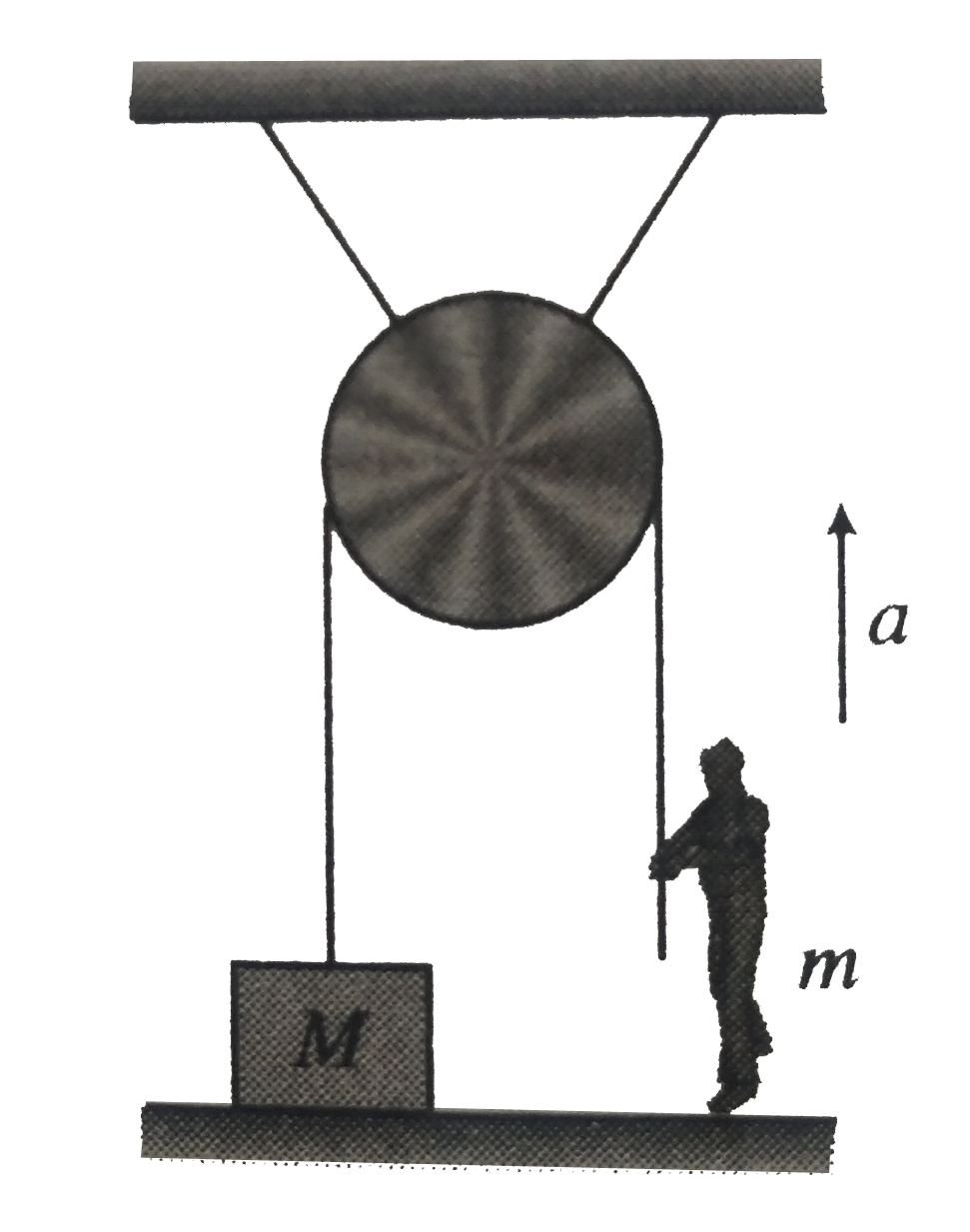
In fig the block of mass M is at rest on the floor. The acceleration with which a boy of mass m should climb along the rope of negligible mass so as to lift the block from the floor is

A

`=((M)/(m)-1)g`

B

`gt ((M)/(m)-1)g`

C

`=(M)/(m)g`

D

` gt (M)/(m)g`

Text Solution

Verified by Experts

The correct Answer is:
B

Equation of motion for M:
Since M is stationary,
`T-mg=0`
`rArr T=Mg" " ...(1)`

Since the boy moves up with an acceleration .a.,
`T-mg=ma`
`rArr T=m(g+a)" " ...(2)`
Equating (1) and (2), we obtain
`Mg=m(g+a)`
`rArr a=((M)/(m)-1)g`
That means, if `a gt ((M)/(m)-1)g`, the block M can be lifted.
Promotional Banner

Similar Questions

Explore conceptually related problems

In fig. the block of mass M is at rest on the floor . At what acceleration with which should a boy of mass m climb along the rope of negligible mass so as to lift the block from the floor?

In fig. the block of mass M is at rest on the floor . At what acceleration with which should a boy of mass m climb along the rope of negligible mass so as to lift the block from the floor?

The block of mass m is at rest. Find the tension in the string A .

A rope of negligible mass passes over a pulley of negligible mass attached to the ceiling, as shown in figure. One end of the rope is held by Student A of mass 70 kg , who is at rest on the floor. The opposite end of the rope is held by Student B of mass 60 kg , who is suspended at rest above the floor. The minimum acceleration a_(0) with which the Student B should climb up the rope to lift the Student A upward off the floor. (g=10m//s^(2))

A rope of negligible mass passes over a pulley of negligible mass attached to the ceiling, as shown in figure. One end of the rope is held by Student A of mass 70 kg , who is at rest on the floor. The opposite end of the rope is held by Student B of mass 60 kg , who is suspended at rest above the floor. The minimum acceleration a_(0) with which the Student B should climb up the rope to lift the Student A upward off the floor. (g=10m//s^(2))

A block of mass 1.0 kg rests on a wedge of angle theta . The acceleration which should be given to the wedge so that the block falls freely is :

A block of mass 25 kg is raised by a 50kg man in two different ways as shown in fig. what is the action on the floor by the man in the two cases? If the floor yields to a normal force of 700N , which mode should the man adopt to lift the block without the floor yielding?

A block of mass 2 kg rests on the floor of an elevator , which is moving down with an acceleration 'g' , then the apparent weight of the block is [ take g = 10 m//s^(2) ]

Two blocks of masses m_1 and m_2 are connected as shown in the figure. The acceleration of the block m_2 is :

A block of mass 'm' is placed on the floor of a lift, moving upward with an uniform acceleration a = g. ( mu is the coefficient of friction between block and the floor of lift). If a horizontal force of umg acts on the block, then horizontal acceleration of the body is .......

