Home
Class 12
PHYSICS
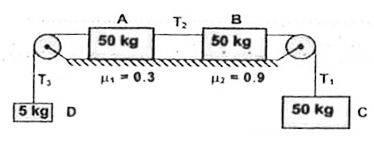
A block pulley arrangement is shown in t...

A block pulley arrangement is shown in the figure. If `f_(1) and f_(2)` represents frictional force acting on the block A and B respectively then choose the correct statement. (given `g=10m//s^(2)`)

A

`T_(1)=100N, T_(2)=10N`

B

`f_(1)=10N, f_(2)=450N`

C

`T_(2)=50N, T_(3)=50N`

D

`f_(1)=50N, T_(2)=50N`

Text Solution

Verified by Experts

The correct Answer is:

C

`f_("max")=f_(1_("max"))+f_(2_("max"))=150+450=600N`
Hence A and B have no acceleration but block C has a tendency to move down.
Hence `T_(1)=500N, f_(2)=450N, T_(2)=50N, T_(3)=50N, f_(1)=0N`
Promotional Banner

Similar Questions

Explore conceptually related problems

Force acting on a block versus time graph is as shown in figure Choose the correct options. (g = 10 m//s^(-2))

In the shown arrangements if f_(1), f_(2) and T be the frictional forces on 2 kg block, 3 kg block & tension in the string respectively, then their values are

A force F" is applied on a block of mass 5 kg as shown in figure. Co-efficient of friction between the wall and clock is (sqrt(3))/(2). (g = 10m//s^(2)) If 'f_(1)" and 'f_(2)' are magnitude of frictional force on the block when F = 40 N and F = 140 N repesctively. Then choose correct options

For the arrangement as shown in the figure the maximum force F, for no relative motion between blocks is

A block B is pulled by a force of 18 N applied to a light pulley as shown in the figure. If the coefficient of friction is 0.4 and the acceleration of the block is 0.5 ms^(-2) , the mass of the block is (g = 10 m//s^2)

A block of mass 6 kg is kept on rough surface as shown in figure. Find acceleration and friction force acting on the block. (Take g=10m//s^(2) )

A block of mass 10 kg is moving on a rough surface as shown in figure. The frictional force acting on block is :-

In the arrangement shown in figure, string is light and inextensible and friction is absent every where. The speed of both blocks after the block 'A' has ascend a height of 1m will be (g=10 m//s^(2))

In the figure shown, (a) find the force of friction acting on the block. (b) state whether the block will move or not. If yes then with what acceleration?

In the figure shown, (a) find the force of friction acting on the block. (b) state whether the block will move or not. If yes then with what acceleration?
