Home
Class 12
PHYSICS
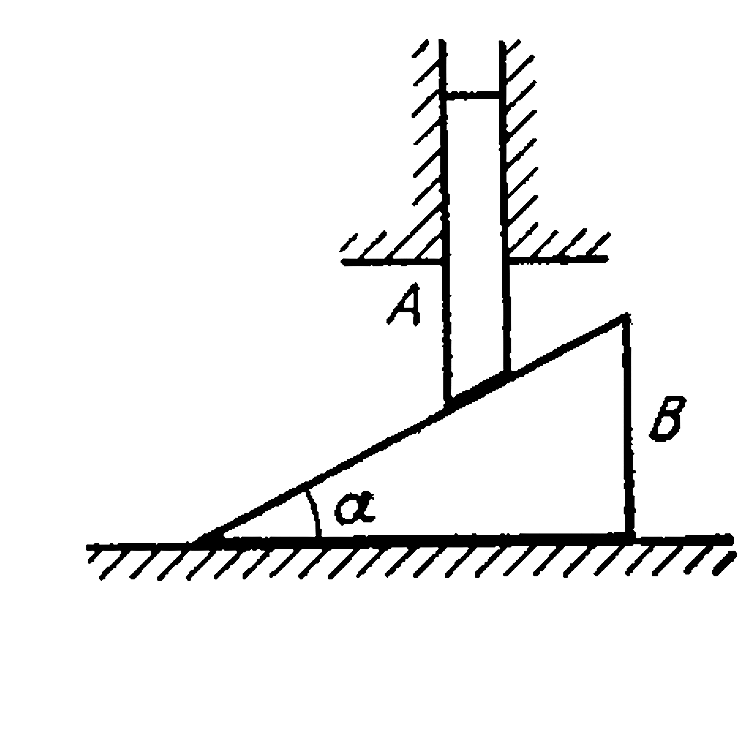
Find the accelerations of rod A and wedg...

Find the accelerations of rod A and wedge B in the arrangement shown in figure if the ratio of the mass of the wedge to that of the rod equals `eta`, and the friction between all contact surfaces is negligible.

Text Solution

Verified by Experts
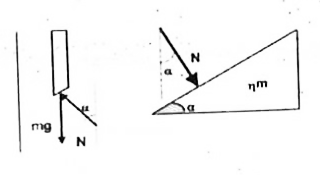

`y=x tan alpha rArr (d^(2)y)/(dt^(2))=(d^(2)x)/(dt^(2)) tan alpha`
`a_("rod")=a_("wedge"). tan alpha " " `(constraint equation)
`mg-N cos alpha=ma_(R)" " & N sin alpha=(eta m).a_("wedge")`
`rArr mg-N cos alpha=m a_(w) tan alpha`
Solving we get,
`a_("wedge")=(g)/(tan alpha+eta cot alpha) and a_("Rod")=(g)/(1+eta cot^(2)alpha)`
Promotional Banner

Similar Questions

Explore conceptually related problems

A rod of mass m is supported on a wedge of mass M shown in fig. Find the accelerations of rod and wedge in the arrangement. The friction between all contact surfaces in negligible.

Find the acceleration of the body of mass m_(2) in the arrangement shown in figure. If the mass m_(2) is eta time the mass m_(1) and the angle that the inclined plane forms with the horizontal is equal to theta . The masses of the pulley and threads, as well as the friction, are assumed to be negligible.

In the arrangement shown in fig. the block of mass m=2kg lies on the wedge of mass M=8kg . The initial acceleration of the wedge, if the surfaces are smooth, is

All the surfaces are smooth as shown in figure. The acceleration of mass m relative to wedge is :

A plank of mass m rests symmetrically on two wedges B and C of mass M. What is the acceleration of the plank? Neglect friction between all the contact surfaces.

A block of weight W is placed on a wedge and arranged as shown in fig. find the force F needed to hold the cart equilibrium if there is no friction.

For no friction to act on a block kept on an accelerating wedge as shown in figure, acceleration a of the wedge should be -

In the arrangement shown in figure the mass of the ball is eta times as that of the rod. The length of the rod is L the masses of the pulleys and the threads as well as the friction, are negligible. The ball is set on the same level as the lower end of the rod and then released. How soon will the ball be opposite the upper end of the rod?

A block on table shown in figure is just on the wedge of slipping. Find the coefficient of static friction between the block and table top.

A block of mass m is released from a wedge of mass m as shown in figure . Find the time taken by the block to reach the end of the wedge.

