Home
Class 12
PHYSICS
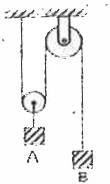
Two blocks 'A' and 'B' having masses m(A...

Two blocks 'A' and 'B' having masses `m_(A)` and `m_(a)`, respectively are connectd by an arrangement shown in the figure. Calculate the downward acceleration of the block B. Assume the pulleys to be massless. Under what condition will block A have downward acceleration?

Text Solution

Verified by Experts

According to Newton `2^(nd)` Law
`m_(B)g-T=m_(B)a_(B)" "("From FBD of " m_(B))" " ...1`

`2T-m_(A)g=m_(A)a_(A)" "("From FBD of "m_(A))" "...2`
Constraint relation
`a_(B) = 2a_(A)=a" "...3`
Solving equation 1, 2 & 3
`a_(B)=a=(2g(2m_(B)-m_(A)))/((4m_(B)+m_(A))), a_(A)= (a)/(2)=(g(2m_(B)-m_(A)))/((4m_(B)+m_(A)))`.
Block A will have downward motion if `a_(A) lt 0 rArr (2m_(B)-m_(A)) lt 0`
`rArr m_(A) gt 2m_(B)`
Promotional Banner

Similar Questions

Explore conceptually related problems

In the arrangement shown, the pulleys and strings are massless. The acceleration of block B is :

Referring to figure calculate the downward acceleration of mass m_1 . Assume the surfaces are frictionless and pullyes are massless.

In the pulley-block arrangement shown in figure , find the relation between acceleration of blocks A and B

In the pulley-block arrangement shown in figure , find the relation between acceleration of blocks A and B

Two block of masses m_(1) and m_(2) are connected as shown in the figure. The acceleration of the block m_(2) is:

Two blocks of masses m_1 and m_2 are connected as shown in the figure. The acceleration of the block m_2 is :

In the figure given below, with what acceleration does the block of mass m will move? (Pulley and strings are massless and frictionless)

Two blocks, each having mass m, are connected with an ideal string through ideal pulleys on a frictionless fixed wedge as shown in the figure. The acceleration of the blocks is

In figure calculate the linear acceleration of the blocks. Mass of block B= 8kg mass of disc shaped pulley =2kg (take g=10m//s^(2) )

Find the relation between acceleration of the two blocks m_(1) and m_(2) . Assume pulleys are massless and frictionless and the strings are inextensible .
