

Home
Class 12
PHYSICS
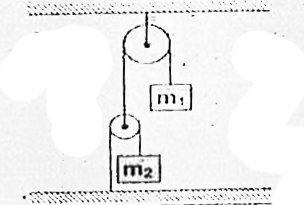
Find the relation between acceleration o...

Find the relation between acceleration of the two blocks `m_(1) and m_(2)`. Assume pulleys are massless and frictionless and the strings are inextensible .

Promotional Banner

Similar Questions

Explore conceptually related problems

Find the accelerations of two blocks. Assume pulleys and strings are massless and frictionless. Also assume the string to be inextensible.

In the given diagram , find the relation between acceleration of blocks m_(1) and m_(2) . ( m_(2) remains horizontal ).

Find the acceleration of blocks in fig. The pulley and the string are massless.

In the figure given below, with what acceleration does the block of mass m will move? (Pulley and strings are massless and frictionless)

In the arrangement , shown below pulleys are massless and frictionless and threads are inextensible , block of mass m_(1) will remain at rest if

In the figure given below , with what acceleration does the block of mass m will move ? ( Pulley and strings are massless and frictionless)

The time period of block of mass m is (Assume pulleys and string are massless) .

In an atwood machine the two blocks have massess 1kg and 3kg . The pulley is massless and frictionless and string is light. The acceleration of the centre of mass (in m//s^(2) ) of this system is 0.5x . Find the value of x .

Find the acceleration of the 6 kg block in the figure. All the surfaces and pulleys are smooth. Also the strings are inextensible and light. [Take g = 10 m//s^(2) ] .

In the given arrangement, mass of the block is M and the surface on which the block is placed is smooth. Assuming all pulleys to be massless and frictionless, strings to be inelastic and light, R_1 , R_2 and R_3 to be light supporting rods, then acceleration of point P will be (A is fixed):