Home
Class 12
PHYSICS
In the figure shown co-efficient of fric...

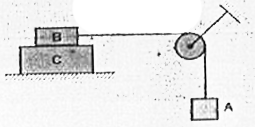
In the figure shown co-efficient of friction between the block B and C is 0.4. There is no friction between the block C and hte surface on which it is placed. The system of blocks is released from rest in the shown situation. Find the distance moved by the block C when block A descends through a distance 2m. Given masses of the blocks are `m_(A)=3 kg, m_(B)=5 kg and m_(C)=10 kg`.

Text Solution

Verified by Experts
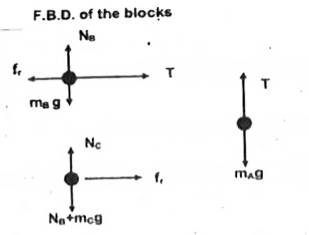

Let there is no relative motion between the blocks B and C
Hence
`T=(m_(B)+m_(C))a" " ...(1)`
And `m_(A)g-T=m_(A)a " "...(2)`
From (1) and (2), we get
`a=(m_(A)g)/(m_(A)+m_(B)+m_(C))=(30)/(18)=(5)/(3)m//s^(2)`
`rArr` Net force on the block C is, `F=m_(c)a=10xx(5//3)N=16.6N`
If maximum value of frictional force acting on block C is`f_("max")`, then
`f_(("max"))=mu m_(B)g=0.4xx5xx10=20N " " because F le f_("max")`
Hence there is no relative between the block B and C. Therefore distance moved by C is 2m only.
Promotional Banner

Similar Questions

Explore conceptually related problems

The coefficient of friction between the block A of mass m and the triangular wedge B of mass M is mu . There in no friction between the wedge and the plane if the system (block A+ wedge B) is released so that there is no stiding between A and B find the inclination theta

Consider the system shown in the figure. Coefficient of friction between the block and table is mu=0.5. The system is released from rest. Find the work done by friction, when the speed of block is 10 m/s (m=1kg)

A block of mass M is placed on the top of a bigger block of mass 10 M as shown in figure. All the surfaces are frictionless. The system is released from rest, then the distance moved by the bigger block at the instant the smaller block reaches the ground :

Calculate angle of friction between wedge and block system is at rest M coefficient of friction between wedge and block.

In the figure shown, the coefficient of static friction between the block A of mass 20 kg and horizontal table is 0.2. What should be the minimum mass of hanging block just beyond which blocks start moving?

In the arrangement shown in Fig there is no friction between of mass 2m and ground but there is friction between the block of masses m is stationary with respect to block of mass 2m The value of friction between m and 2m is

The block A in the given figure is of mass 10sqrt(3) kg The coefficient of friction between the block and the surface on which it rests is 0.5. Find maximum mass of block B possible such that the system will be in equilibrium is.

The blocks A and B shown in figure have masses M_A=5kg and M_B=4kg . The system is released from rest. The speed of B after A has travelled a distance 1m along the incline is

The block of mass M and are arrenged as the situation in fig is shown.The coefficient of friction between two block is mu and that between the bigger block and the ground is mu find the acceleration of the block

Consider the situatioin shown in figure. The system is released from rest and the block of mass 1.0 kg is found to have a speed 0.3 m/s ater it has descended thrugh a distance of 1 m. find the coefficient of kinetic friction between the block and the table.

