Home
Class 12
PHYSICS
A 42 kg slab rests on a frictionless flo...

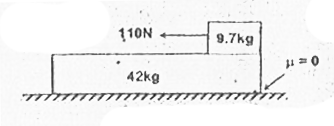
A 42 kg slab rests on a frictionless floor A 9.7 kg block rests on the top of the slab as shown in the figure. The co-efficient of static friction between the block and the slab is 0.53, while the co-efficient of kinetic friction is 0.38. The 9.7 kg block is acted upon by a horizontal force of 110 N. What are the resulting accelerations of
(a) the block, and (b) the slab? (Take `g=9.8m//s^(2)`)

Text Solution

Verified by Experts
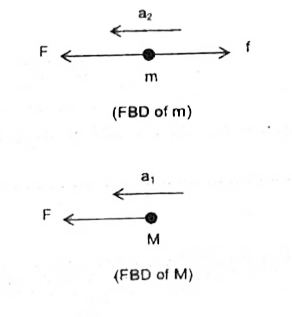

(a) From FBD of m
`F-mu_(k)mg=ma_(2)`
`a_(2)=(F)/(m)-mu_(k)g=((110N))/((9.7kg))-(0.38)(9.8m//s^(2))`
`=7.6m//s^(2)` (towards left)
(b) From FBD of M
`f=Ma_(1) rArr (mu_(k)mg)/(M)=a_(1)`
`a_(1)=((0.38)(9.7kg)(9.8m//s^(2)))/((42kg))`
`=0.86m//s^(2)` (towards left)
Promotional Banner

Similar Questions

Explore conceptually related problems

A 40 kg slab rests on a frictionless floor. A 10 kg block rests on top of the slab. The coefficient of friction between the block and the slab is 0.40. The 10 kg block is acted upon by a horizontal force of 100 N. If g=10m//s^(2) , the resulting acceleration of the slab will be

A block B of mass 5kg is placed on a slab A of mass 20kg which lies on a frictionless surface as shown in the figure. The coefficient of static friction between the block and the slab is 0.4 and that of kinetic friction is 0.2. If a force F = 25N acts on B, the acceleration of the slab will be:

A force of 200N is applied as shown in the figure on block of 3 kg. The coefficient of friction between the block and the wall is 0.3. Find the friction acting on the block. (in N) {Take g = 10 m//s^(2)

A block of mass 2kg rests on a rough inclined plane making an angle of 30^@ with the horizontal. The coefficient of static friction between the block and the plane is 0.7. The frictional force on the block is

A block of mass 2kg rests on a rough inclined plane making an angle of 30^@ with the horizontal. The coefficient of static friction between the block and the plane is 0.7. The frictional force on the block is

A block of mass 3 kg rests on a rough inclined plane making an angle of 30^(@) . With the horizontal. The coefficient of static friction between the block and the plane is 0.7. The frictional force on the block is

Block A of mass 35kg is resting on a frictionless floor. Another block B of mass 7kg is resting on it as shown in the figure. The coefficient of friction between the blocks is 0.5 while kinetic friction is 0.4. (g = 10ms^(-2)) The minimum value of force to cause block B to move with respect to block Ais :

A force of 100 N is applied on a block of mass 3 kg as shown in figure. The coefficient of friction between the surface and the block is 1/4 .Then the friction force acting on the block is

A block rests on a rough inclined plane making an angle of 30^@ with the horizontal. The coefficient of static friction between the block and the plane is 0.8. If the frictional force on the block is 10N, the mass of the block (in kg) is

A slab of 40 kg lying on a frictionales floor and a block of 10 kg rests on the slab as shown in the figure. The coefficients of static and kinetic friction between the slab and the block are 0.6 and 0.4 respectively. If a force of 100 N is applied on the block, then the acceleration the slab will be (g = 10 m//s^(2))

