Home
Class 12
PHYSICS
Spring is mounted as shown in figure. By...

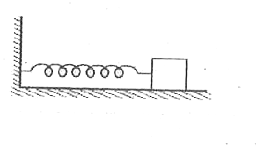
Spring is mounted as shown in figure. By attaching a mass to the free end and pulling side ways, we determine that the force is proportional to the displacement a force of 4N causing a displacement of 0.02 m. We attach a 2kg body to the end, pull it aside through a distance of 0.04m , and then released. Find

maximum velocity atained by the body.

Text Solution

Verified by Experts

The maximum velocity occurs at the equilibrium position, where the x-coordinate is zero. Since
`v = +- omega sqrt(A^(2) - x^(2))`, then when x = 0
`v = v_("max") = +- omega A = +- 10 xx 0.04 m//s = 0.4 m//s`
Promotional Banner

Similar Questions

Explore conceptually related problems

Spring is mounted as shown in figure. By attaching a mass to the free end and pulling side ways, we determine that the force is proportional to the displacement a force of 4N causing a displacement of 0.02 m. We attach a 2kg body to the end, pull it aside through a distance of 0.04m , and then released. Find maximum acceleration of the body.

Spring is mounted as shown in figure. By attaching a mass to the free end and pulling side ways, we determine that the force is proportional to the displacement a force of 4N causing a displacement of 0.02 m. We attach a 2kg body to the end, pull it aside through a distance of 0.04m , and then released. Find the velocity adn acceleration when the body has moved half way in toward the central from is initial position.

Spring is mounted as shown in figure. By attaching a mass to the free end and pulling side ways, we determine that the force is proportional to the displacement a force of 4N causing a displacement of 0.02 m. We attach a 2kg body to the end, pull it aside through a distance of 0.04m , and then released. Find How much time is required for the body to move half way into the center from its initial position?

Spring is mounted as shown in figure. By attaching a mass to the free end and pulling side ways, we determine that the force is proportional to the displacement a force of 4N causing a displacement of 0.02 m. We attach a 2kg body to the end, pull it aside through a distance of 0.04m , and then released. Find the force constant of the spring

Spring is mounted as shown in figure. By attaching a mass to the free end and pulling side ways, we determine that the force is proportional to the displacement a force of 4N causing a displacement of 0.02 m. We attach a 2kg body to the end, pull it aside through a distance of 0.04m , and then released. Find the period and frequency of vibration.

A body travels uniformly a distance of (20.0 pm 0.2)m in time (4.0 pm 0.04)s . The velocity of the body is

The force constant of a weightless spring is 16 N m^(-1) . A body of mass 1.0 kg suspended from it is pulled down through 5 cm and then released. The maximum energy of the system (spring + body) will be

A spring of force constant 600 Nm^(-1) is mounted on a horizontal table. A mass of 1.5 kg is attached to the free end of the spring,pulled sideways to a distance of 2 cm and released . The speed of the mass when the spring is compressed by 1 cm is

A spring of force constant 600 Nm^(-1) is mounted on a horizontal table. A mass of 1.5 kg is attached to the free end of the spring, pulled sideways to a distance of 2 cm and released .P.E. of the mass when it momentarily comes to rest and total energy are

Force constant of a weightless spring is 16 Nm^(-1) . A body if mass 1 kg suspended from it is pulled down through 5 cm from its mean position and then released. The maximum kinetic energy of the body will be
