Home
Class 12
PHYSICS
A ring of mass m and radius a is connect...

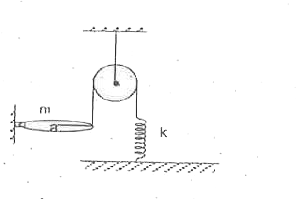
A ring of mass m and radius a is connected to an inextensible string which passes over a frictionless pulley. The other end of string is connected to upper end of a massless spring of spring constant k. The lower end of the spring is fixed. The ring can rotate in the vertical plane about hinge without any friction. If horizontal position of ring is equilibrium position then find time period of small in oscillations of the ring.

Text Solution

Verified by Experts
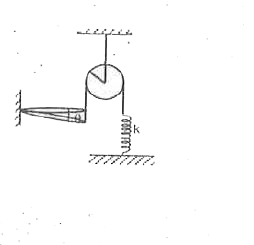
When displacement of the ring is `theta`, then extension in spring `= (2a theta + x_(0))`
Energy of system
`E = (1)/(2) k (2a theta + x_(0))^(2) - mg a theta + (1)/(2)l ((d theta)/(dt))^(2)`
`E = (1)/(2) k (2a theta + x_(0))^(2) - mg a theta + (1)/(2) ((1)/(2) ma^(2) + ma^(2)) ((d theta)/(dt))^(2)`
`rArr (dE)/(dt) = k (2a theta + x_(0)) 2a (d theta)/(dt) - mg a (d theta)/(dt) + (3)/(2) ma^(2) ((d theta)/(dt)) (d^(2) theta)/(dt^(2))`
As `(dE)/(dt) = 0, k (2 a theta + x_(0)) 2a - mg a = - (3)/(2) ma^(2) (d^(2) theta)/(dt^(2))`
`4ak theta + 2a k x_(0) - mg a = - (3)/(2) ma^(2) (d^(2) theta)/(dt^(2))`
`:. (8)/(3) (k)/(m) theta = - (d^(2) theta)/(dt^(2))`
`:. omega = sqrt((8k)/(3m))`
`:. T = 2pi sqrt((3m)/(8k))`
Promotional Banner

Similar Questions

Explore conceptually related problems

A block of mass m hangs from a vertical spring of spring constant k. If it is displaced from its equilibrium position, find the time period of oscillations.

Two masses 2 kg and 4 kg are connected at two ends of light inextensible string passing over a frictionless pulley . If the masses are released , then find the accelaration of the masses and the tension in the string .

A uniform semicircular ring of mass m and radius r is hinged at end A so that it can rotate freely about end A in the vertical plane as shown in the figure. Calculate angle made by line AB with vertical in equilibrium position and time period of small oscillation of ring.

Two masses 2 kg and 4 kg are connected at the two ends of light inextensible string passing over a frictionless pulley. If the masses are released, then find the acceleration of the masses and the tension in the string.

Two blocks of masses m_1 = 4 kg and m_2 = 2 kg are connected to the ends of a string which passes over a massless, frictionless pulley. The total downwards thrust on the pulley is nearly

Two bodies of masses 4 kg and 6 kg are tied to the ends of a massless string. The string passes over a frictionless pulley. The acceleration of the system is :

A mass of 0.2 kg is attached to the lower end of a massless spring of force constant 200(N)/(m) the other end of which is fixed to a rigid support. Study the following statements.

A light pulley is suspended at the lower end of a spring of constant k_(1) , as shown in figure. An inextensible string passes over the pulley. At one end of string a mass m is suspended, the other end of the string is attached to another spring of constant k_(2) . The other ends of both the springs are attached to rigid supports, as shown. Neglecting masses of springs and any friction, find the time period of small oscillations of mass m about equilibrium position.

Two masses of 3 kg and 4 kg are connected at the two ends of a light inextensible string that passes over a frictionless pulley. Find the acceleration of the masses and the tension in the string, when the masses are released.

A 10 kg mass is connected at one end of a massless spring with force constant k = 1000 N/m, keeping other end fixed in a horizontal plane as shown in the fig. 15.6 If the sytem is displaced by 0.01 m from its equilibrium position A to a point B, then the acceleration of the system is

