Home
Class 12
PHYSICS
Two blocks A and B. each of mass m, are ...

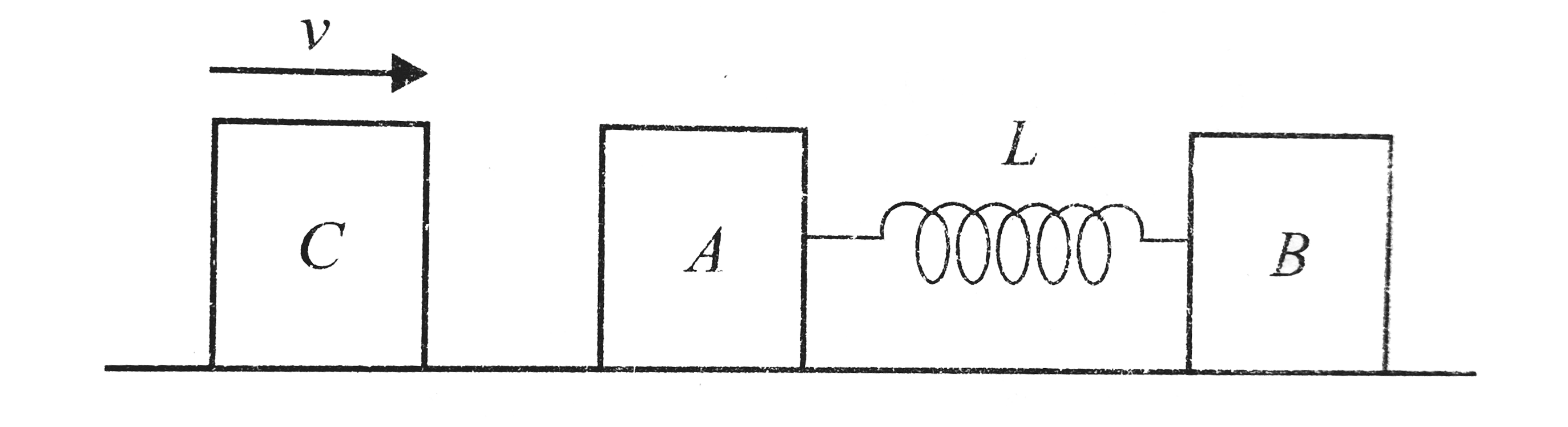
Two blocks `A` and `B`. each of mass `m`, are connected by a massless spring of natural length `I`. and spring constant `K`. The blocks are initially resting in a smooth horizontal floor with the spring at its natural length, as shown in Fig. A third identical block `C`, also of mass `m`, moves on the floor with a speed `v` along the line joining `A` and `B`. and collides elastically with `A`. Then

A

the kinetic energy of AB system at maximum compression of the spring is zero.

B

the kinetic energy of the AB system at maximum compression of the spring is `(mv^(2))/(4)`

C

The maximum compression of the spring is `v sqrt(m//k)`

D

the maximum compression of the spring is `v sqrt(m//2k)`

Text Solution

Verified by Experts

The correct Answer is:
A, B, D

Due to equal mass, C transfers its total momentum of A. Therefore A has the velocity v.At maximum compression the velocity of both the bodies are equal say, v. .
Conservation of linear momentum yields

`mv = (m + m)v.`
`rArr v. = (v//2)`
`:.` The K.E. of the system `= (1)/(2) (m + m)v^(2)`
`=(1)/(2) (2m) (v^(2))/(4) = (mv^(2))/(4)`
`(1)/(2) kx^(2) = Delta KE = (mv^(2))/(2) - (mv^(2))/(4)`
`rArr x= (sqrt((m)/(2k)))v`
Promotional Banner

Similar Questions

Explore conceptually related problems

Two identical blocks A and B , each of mass m resting on smooth floor are connected by a light spring of natural length L and spring constant k , with the spring at its natural length. A third identical block C (mass m ) moving with a speed v along the line joining A and B collides with A . The maximum compression in the spring is

A block of mass m is connected to another block of mass M by a massless spring of spring constant k . the blocks are kept of a smooth horizontal plane and are at rest. The spring is unstretched when a constant force F starts acting on the block of mass M of pull it. Find the maximum extension of the spring

Two blocks of masses m_(1) and m_(2) are connected by a massless spring and placed on smooth surface. The spring initially stretched and released. Then :

A block of mass m lie on a horizontal smooth surface and connected with the springs at their natural length as shown in figure. When block slightly displaced then find the time period of oscillation.

Two identical blocks A and B each of mass M are connected to each other through a light string. The system is placed on a smooth horizontal floor. When a constant force F is applied horizontally on the block A, find the tension in the string.

A block of mass m is connect to another block of mass M by a massless spring of spring constant k. The blocks are kept on a smooth horizontal plane. Initially the blocks are at rest and the spring is upstretched when a constant force F starts acting on the block of mass M to pull it. Find the maximum extension of the spring.

Two blocks A and B of masses in and 2m , respectively, are connected with the help of a spring having spring constant, k as shown in Fig. Initially, both the blocks arc moving with same velocity v on a smooth horizontal plane with the spring in its natural length. During their course of motion, block B makes an inelastic collision with block C of mass m which is initially at rest. The coefficient of restitution for the collision is 1//2 . The maximum compression in the spring is

A block of mass m is connect to another block of mass M by a massless spring of spring constant k. The blocks are kept on a smooth horizontal plane. Initially the blocks are at rest and the spring is unsrtretched when a constnt force F starts acting on the block of mass M to pull it. Find the maximum extension of the spring.

A block of mass m is connected to another .block of mass M by a massless spring of spring constant k. A constant force f starts action as shown in figure, then:

Two blocks A and B of mass m and 2m respectively are connected by a light spring of force constant k. They are placed on a smooth horizontal surface. Spring is stretched by a length x and then released. Find the relative velocity of the blocks when the spring comes to its natural length