Home
Class 12
PHYSICS
A uniform bar with mass m lies symmetric...

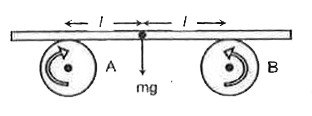
A uniform bar with mass m lies symmetrically across two rapidly rotating fixed rollers. A and B with distance 'l' between the bars centre of mass and each roller. The rollers whose direction of rotation are shown in figure slip against the bar with coefficient of friction `mu`. Suppose the bar is displaced horizontally by a small distance 'x' and then released, find the time period of oscillation.

Text Solution

Verified by Experts

`2pi sqrt((l)/(mu g))`
Promotional Banner

Similar Questions

Explore conceptually related problems

A uniform bar with mass m lies symmetrically across two rapidly rotating fixed rollers, A and B with distance L=2.0 cm between the bar's centre of mass and each roller. The rollers, whose directions of rotation are shown in figures slip against the bar with coefficient of kinetic friction mu_(k)=0.40 . suppose the bar is displaced horizontally by the distance x as shown in figure and then released. the angular frequency omega of the resulting horizontal simple harmonic motion of the bar is (in rad" "s^(-1) )

The ends of a rod of length l and mass m are attached to two identical springs as shown in the figure. The rod is free to rotate about its centre O . The rod is depressed slightly at end A and released . The time period of the oscillation is

Two particles A and B , each carrying charge Q are held fixed with a separation D between them. A particle C having mass m and charge q is kept at the middle point of the line AB. If particle C is displaced through a distance x along the line AB. What will be the time period of the oscillations.

A uniform stick of length l is mounted so as to rotate about a horizontal axis perpendicular to the stick and at a distance d from the centre of mass. The time period of small oscillation has a minimum value when d//l is

A thin bar of mass m and length l is free to rotate about a fixed horizontal axis through a point at its end.The bar is brought to a horizontal position. (theta = 90^(@)) and then released. The angular velocity when it reaches the lowest point is

A uniform slender bar B of mass m and length L supported by a firctionless pivot at A is released from rest at its vertical position as shown the figure. Calculate the reaction at pivot when the bar just acquires the horizontal position shown dotted.

An L-shaped bar of mass M is pivoted at one of its end so that it can freely rotate in a vertical plane, as shown in the figure a. Find the value of theta_(0) at equilibrum b. If it is slighly displacement from its equilibrum position, find the frequency of oscillation.

A block of mass m is kept on horizontal turn table at x distance from the centre. If coefficient of friction between block and surface of turn table is mu , then maximum angular speed of the table so that block does not slip

A uniform horizontal plank is resting symmetrically in a horizontal position on two cylindrical droms , which are apinning in in opposite direction about their horizontal axes with equal angular velocity . The distance between the axes with equal angular velocity. The distance between the axes is 2 L and the coefficient of friction between the plank and cylender is mu . If the plank is displaced slightly from the equilibrium position along its length and released, show that it performs simple horizontal motion. Caculate also the time period of motion.

two light identical springs of spring constant K are attached horizontally at the two ends of a uniform horizontal rod AB of length l and mass m. the rod is pivoted at its centre 'o' and can rotate freely in horizontal plane . The other ends of the two springs are fixed to rigid supportss as shown in figure . the rod is gently pushed through a small angle and released , the frequency of resulting oscillation is :
