Home
Class 12
PHYSICS
Passage II) Two identicla blocks P and Q...

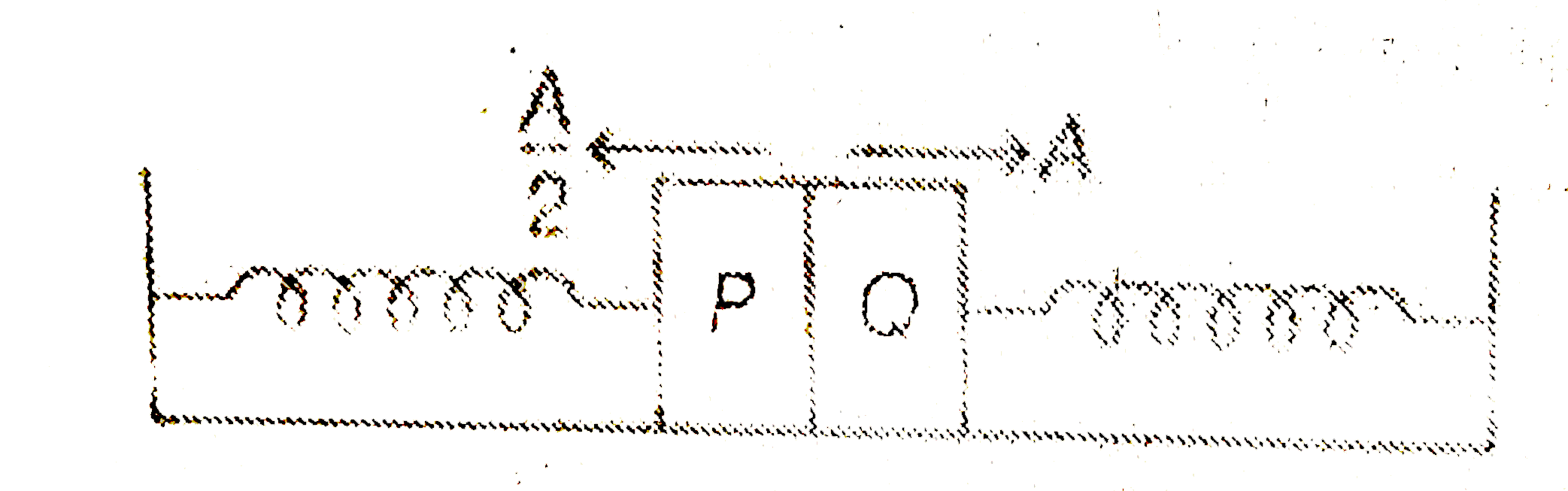
Passage II) Two identicla blocks P and Q have masses m each. They are attached to two identical springs initially unstretched. Now the left spring (along with P) is compressed by `A/2` and the right spring (along with Q) is compressed by A. Both the blocks are released simultaneously. They collide perfectly inelastically. Initially time period of both blocks was T.

The amplitude of combined mass is

A

A/4

B

A/2

C

2A/3

D

3A/4

Text Solution

Verified by Experts

The correct Answer is:

A
Promotional Banner

Similar Questions

Explore conceptually related problems

Passage II) Two identicla blocks P and Q have masses m each. They are attached to two identical springs initially unstretched. Now the left spring (along with P) is compressed by A/2 and the right spring (along with Q) is compressed by A. Both the blocks are released simultaneously. They collide perfectly inelastically. Initially time period of both blocks was T. The time period of oscillation of combined mass is

Passage II) Two identicla blocks P and Q have masses m each. They are attached to two identical springs initially unstretched. Now the left spring (along with P) is compressed by A/2 and the right spring (along with Q) is compressed by A. Both the blocks are released simultaneously. They collide perfectly inelastically. Initially time period of both blocks was T. What is energy of osciallation of the combined mass?

Two masses m and 2m are attached to two ends of an ideal spring as shown in figure. When the spring is in the compressed state, the energy of the spring is 60 J, if the spring is released, then at its natural length

Two blocks of mass M and m, are used to compress two different massless spring as shown. The left spring is compressed by 3 cm, while the right spring is compressed by an unknown amount.. The system is at rest, and all surfaces fixed and smooth. Which of the following statements are true?

In the figure, the block of mass m, attached to the spring of stiffness k is in correct with the completely elastic wall, and the compression in the spring is e. The spring is compressed further by e by displacing the block towards left and is then released. If the collision between the block and the wall is completely eleastic then the time period of oscillation of the block will be

Two blocks of masses 6 kg and 3 kg are attached to the two ends of a massless spring of spring constant 2 pi^(2) N//m . If spring is compressed and released on a smooth horizontal surface then find the time period (in seconds) of each block.

Two blocks of masses m and m' are connected by a light spring on a horizontal frictionless table . The spring is compressed and then released . Find the ratio of acceleration of masses .

Two identical blocks A and B of mass m each are connected to each other by spring of spring constant k. Block B is initially shifted to a small distance x_(0) to the left and then released. Choose the correct statements for this problem, after the spring attains it's natural length.

A block of mass m is attached to two unstretched springs of spring constant k , each as shown. The block is displaced towards right through a distance x and is released The speed of the block as it passes through the mean position will be

The time period of oscillations of a block attached to a spring is t_(1) . When the spring is replaced by another spring, the time period of the block is t_(2) . If both the springs are connected in series and the block is made to oscillate using the combination, then the time period of the block is
