Home
Class 12
PHYSICS
The basic principle underlying the Hall ...

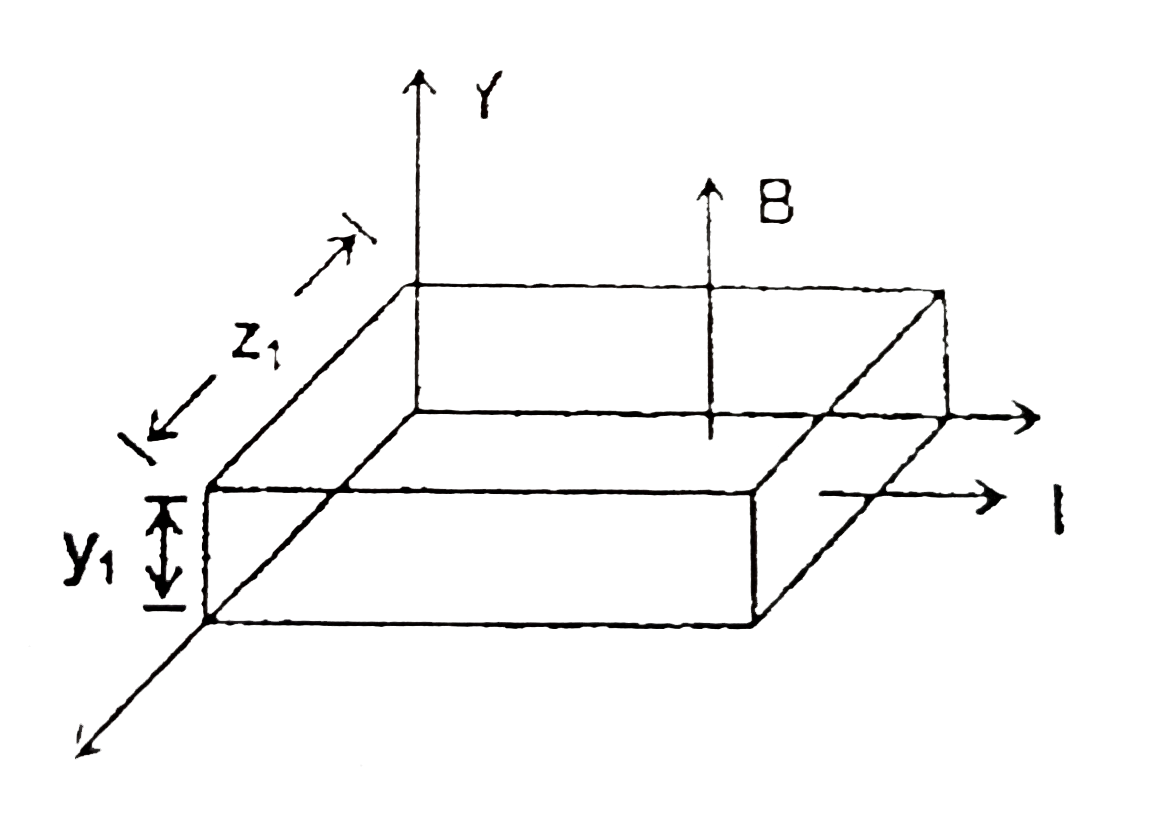
The basic principle underlying the Hall effect is the Lorentz force. When an electron moves along a direction perpendicular to an applied magnetic field, it experiences a force acting normal to both the directions and moves in response to this force and the force exerted by the internal electric field. For an `n`-type, `"bar"`-shaped semiconductor, the carriers are predominantly electrons of bulk density `n`. We assume that the constant current `I` flows along the `x`-axis from left to right in the presence of a magnetic field toward `y`-axis. Electrons subjected to the lorentz force initially drift away from the current line toward the negative `z`-axis, resulting in an excess surface electrical charge on the sides of the sample. This charge results in the hall voltage, a potential drop across the two sides of the sample.
The transverse voltage is the hall voltage `V_(H)` and its magnitude is equal to `IB//qnd`, where `I` is the current, `B` is the magnetic field, `d` is the sample thickness and `q` is the elementary charge. A silver ribbon lies as shown in the adjacent figure. (`z_(1)=11.8 mm` and `y_(1)=0.23 mm`) carrying a current of `120 A` in the `x`-direction in a uniform magnetic field `B=0.95 T`. If electron density is `5.85xx10^(28)//m^(3)`, then
Magnitude of the drift velocity of elelctrons is

A

53 mv

B

`53 mu V`

C

5.3 mV

D

`5.3 mu V`

Text Solution

Verified by Experts

The correct Answer is:

B
Promotional Banner

Similar Questions

Explore conceptually related problems

The basic principle underlying the Hall effect is the Lorentz force. When an electron moves along a direction perpendicular to an applied magnetic field, it experiences a force acting normal to both the directions and moves in response to this force and the force exerted by the internal electric field. For an n -type, "bar" -shaped semiconductor, the carriers are predominantly electrons of bulk density n . We assume that the constant current I flows along the x -axis from left to right in the presence of a magnetic field toward y -axis. Electrons subjected to the lorentz force initially drift away from the current line toward the negative z -axis, resulting in an excess surface electrical charge on the sides of the sample. This charge results in the hall voltage, a potential drop across the two sides of the sample. The transverse voltage is the hall voltage V_(H) and its magnitude is equal to IB//qnd , where I is the current, B is the magnetic field, d is the sample thickness and q is the elementary charge. A silver ribbon lies as shown in the adjacent figure. ( z_(1)=11.8 mm and y_(1)=0.23 mm ) carrying a current of 120 A in the x -direction in a uniform magnetic field B=0.95 T . If electron density is 5.85xx10^(28)//m^(3) , then What is the value of hall emf ?

A charged particle moving in a magnetic field experiences a resultant force

Will a current loop placed in a magnetic field always experience a zero force?

As the bar shown in figure moves in a direction perpendicular to the field, is an external force required to keep it moving with constant speed.

A charge q moves region in a electric field E and the magnetic field B both exist, then the force on its is

When an electron is accelerated through a potential difference V , it experience a force F through as uniform transverse magnetic field. If the potential difference is increased to 2 V, the force experoenced by the electron in the same magnetic field is

A current carrying conductor placed in a magnetic field experiences maximum force when angle between current and magnetic field is :

An electron moving towards the east enters a magnetic field directed towards the north. The force on the electron will be directed

Assertion : Magnetic force is always perpendicualr to the magnetic field. Reason : Electric force is along the direction of electric field.

If a proton is projected in a direction perpendicular to a uniform magnetic field with velocity v and and electron is projected along the line of force, what will happen to proton and electron?
