Home
Class 12
PHYSICS
A rod PQ mass 'm' and length l can slide...

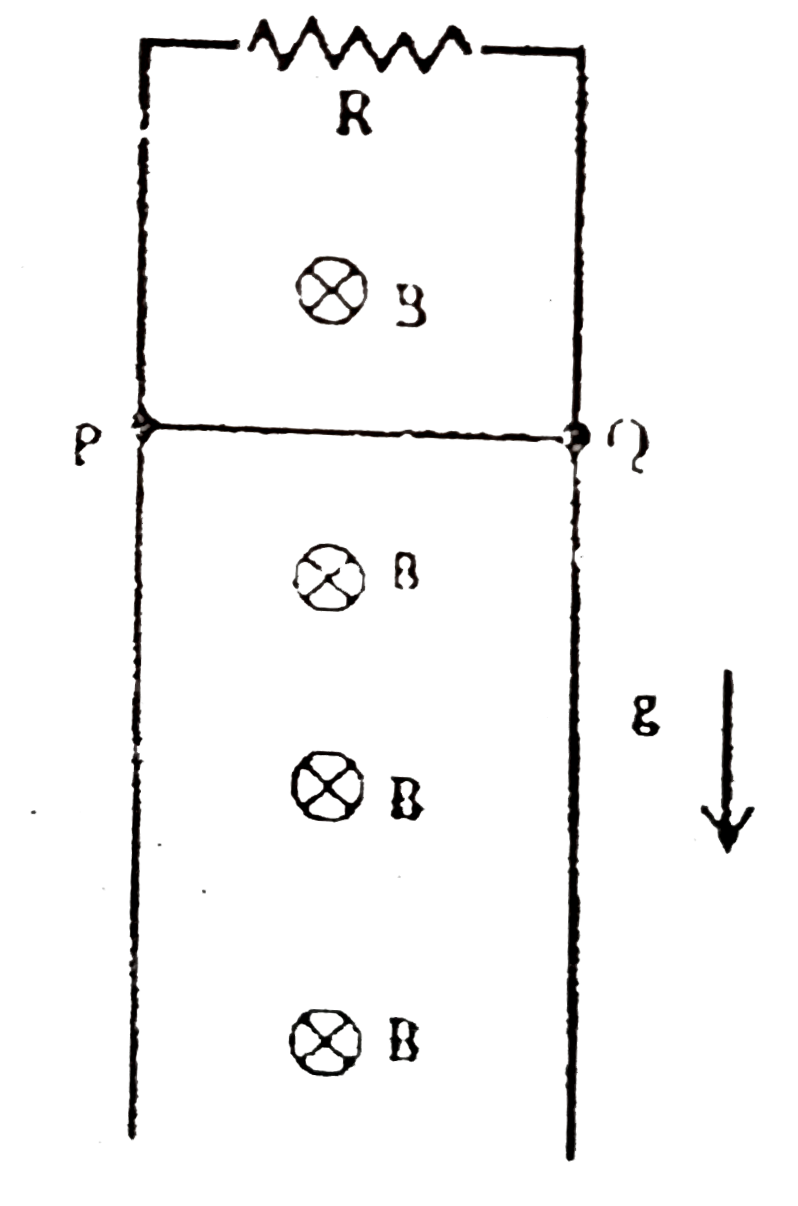
A rod `PQ` mass `'m'` and length `l` can slide without friction on two vertical conducting semi infinite rails. It is given a velocity `V_(0)` downwards, so that it continues to move downward with the same speed `V_(0)` on its own at any later instant of time. Assuming g to be constant every where, the value of `V_(0)` is :-

A

`(mgR) /(2B^(2)L^(2))`

B

`(mgR)/(B^(2)L^(2))`

C

zero

D

any value

Text Solution

Verified by Experts

The correct Answer is:

B

`(B^(2)V_(0)L^(2))/(R ) = mg implies V_(0)= (mgr)/(B^(2)L^(2))`
Promotional Banner

Similar Questions

Explore conceptually related problems

A conducting wire of length l and mass m can slide without friction on two parallel rails and is connected to capacitance C . Whole system lies in a magnetic field B and a constant force F is applied to the rod. Then

A conducting wire of length l and mass m can slide without friction on two parallel rails and is connected to capacitance C . The whole system lies in amagnetic field B and a constant force F is applied to the rod . Then

A conducting wire xy of lentgh l and mass m is sliding without friction on vertical conduction rails ab and cd as shown in figure. A uniform magnetic field B exists perpendicular to the plane of the rails, x moves with a constant velocity of

A conducting wire xy of lentgh l and mass m is sliding without friction on vertical conduction rails ab and cd as shown in figure. A uniform magnetic field B exists perpendicular to the plane of the rails, x moves with a constant velocity of

A uniform rod of mass m and length L is hinged at one end and free to rotate in the horizontal plane. All the surface are smooth. A particle of same mass m collides with the rod with a speed V_(0) . The coefficient of restitution for the collision is e=(1)/(2) . If hinge reaction during the collision is zero then the value of x is :

A conducting rod of length L slides at a constant velocity V on two parallel conducting rails as shown in figure. The mechanical power required to pull the rod at constant velocity is

A particle moves with an initial velocity V_(0) and retardation alpha v , where alpha is a constant and v is the velocity at any time t. Velocity of particle at time is :

A rod of mass M and length L is falling vertically with speed v . Suddenly its one end gets stuck in a friciitonless hook. Find the angular velocity of the rod just after its end gets struck.

A rod of mass m and length l in placed on a smooth table. An another particle of same mass m strikes the rod with velocity v_(0) in a direction perpendicular to the rod at distance x( lt l//2) from its centre . Particle sticks to the end. Let omega be the angular speed of system after collision , then As x is increased from 0 to l/2 , the angular speed omega .

A particle moves with an initial velocity V_(0) and retardation alpha v , where alpha is a constant and v is the velocity at any time t. After how much time, speed of particle decreases by 75%
