Home
Class 12
PHYSICS
Two parallel vertical metallic rails AB ...

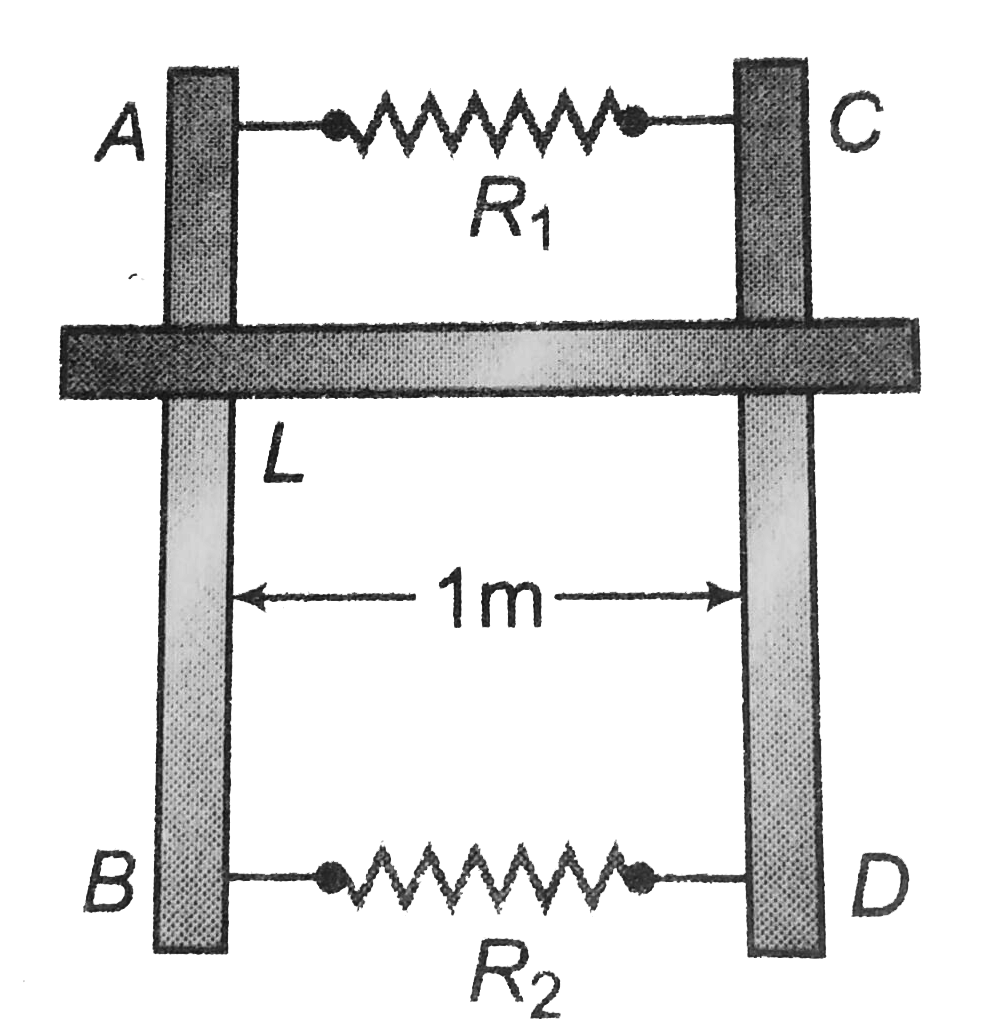
Two parallel vertical metallic rails `AB` and `CD` are separated by `1m`. They are connected at the two ends by resistances `R_1` and `R_2` as shown in the figure. A horizontal metallic bar `l` of mass `0.2 kg` slides without friction, vertically down the rails under the action of gravity. There is a uniform horizontal magnetic field of `0.6 T` perpendicular to the plane of the rails. It is observed that when the terminal velocity is attained, the powers dissipated in `R_1` and `R_2` are `0.76W` and `1.2W` respectively `(g=9.8m//s^2)`

The value of `R_1` is

A

`(9)(19) Omega`

B

0.2`Omega`

C

`5Omega`

D

`0.3 Omega`

Text Solution

Verified by Experts

The correct Answer is:

A

Further, as in case of Joule heating
`P = (V^(2))/(R )` i.e., `R = (V^(2))/(P )`
and as here, `V_(1) = V_(2) = ` e `" so, " R_(1) (e^(2))/(P_(1)) = ((0.6)^(2))/(0.76) = (9)/(19)Omega `
`therefore ` (A)
Promotional Banner

Similar Questions

Explore conceptually related problems

Two parallel vertical metallic rails AB and CD are separated by 1m . They are connected at the two ends by resistances R_1 and R_2 as shown in the figure. A horizontal metallic bar l of mass 0.2 kg slides without friction, vertically down the rails under the action of gravity. There is a uniform horizontal magnetic field of 0.6 T perpendicular to the plane of the rails. It is observed that when the terminal velocity is attained, the powers dissipated in R_1 and R_2 are 0.76W and 1.2W respectively (g=9.8m//s^2) The terminal velocity fo the bar L will be

A conducting wire xy of lentgh l and mass m is sliding without friction on vertical conduction rails ab and cd as shown in figure. A uniform magnetic field B exists perpendicular to the plane of the rails, x moves with a constant velocity of

A conducting wire xy of lentgh l and mass m is sliding without friction on vertical conduction rails ab and cd as shown in figure. A uniform magnetic field B exists perpendicular to the plane of the rails, x moves with a constant velocity of

A copper rod of mass m slides under gravity on two smooth parallel rails l distance apart set at an angle theta to the horizontal. At the bottom, the rails are joined by a resistance R . There is a uniform magnetic field perpendicular to the plane of the rails. the terminal valocity of the rod is

Two parallel vertical metallic bars XX.and YY., of negligible resistance and separated by a length .l., are as shown in Fig. The ends of the bars are joined by resistance R_(1) and R_(2) . A uniform magnetic field of induction B exists in space normal to the plane of the bars. A horizontal metallic rod PQ of mass m starts falling vertically, making contact with the bars. It is observed that in the steady state the powers dissipated in the resistance R_(1) and R_(2) are P_(1) and P_(2) respectively. Find an expression for R_(1), R_(2) and the terminal velocity attained by the rod PQ

A vertical ring of radius r and resistance on R falls vertically. It is in contact with two vertical rails which are joined at the top. The rails are without friction and resistance. There is a horizontal uniform, magnetic field of magnitude B perpendicular to the plane of the ring and the rails. When the speed of the ring is v , the current in the section PQ is

A vertical ring of radius r and resistance on R falls vertically. It is in contact with two vertical rails which are joined at the top. The rails are without friction and resistance. There is a horizontal uniform, magnetic field of magnitude B perpendicular to the plane of the ring and the rails. When the speed of the ring is v , the current in the section PQ is

A wire cd of length l and mass m is sliding without friction on conducting rails ax and by as shown. The verticle rails are connected to each other with a resistance R between a and b . A uniform magnetic field B is applied perpendicular to the plane abcd such that cd moves with a constant velocity of

The system containing the rails and the wire of the previous problem is kept vertically in a uniform horizontal magnetic field B that is perpendicular to the plane of the rails. It is found that the wire stays in equilibrium. If the wire ab is replaced by another of double its mass, how long will it take in falling through a distance equal ot its length?

Shows a wire sliding on two parallel, conducting rails placed at a separaton l. A magnetic feld B exists in a direction perpendicular to the plane of the rails. What force is necessary to keep the wire moving at a constatn velocity v ?
