Home
Class 12
PHYSICS
A conducting rod AB of lemgth 2 l moves ...

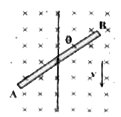
A conducting rod AB of lemgth 2 l moves through a uniform magnetic field B. The rod makes an angle `theta ` with the vertical while it falls with a uniform linear velocity v. The potential difference between the two ends of the rod is `Bv^(2)l` .

Text Solution

Verified by Experts

The correct Answer is:

False
Promotional Banner

Similar Questions

Explore conceptually related problems

A small conducting rod of length l, moves with a uniform velocity v in a uniform magnetic field B as shown in fig __

A glass rod of length l moves with velocity v in a uniform magnetic field B. What is the e.m.f induced in the rod?

A rod of length l rotates with a uniform angular velocity omega about its perpendicular bisector. A uniform magnetic field B exists parallel to the axis of rotation. The potential difference between the two ends of the lrod is

A rod of length l rotates with a uniform angular velocity omega about its perpendicular bisector. A uniform magnetic field B exists parallel to the axis of rotation. The potential difference between the two ends of the lrod is

A rod AB moves with a uniform velocity v in a uniform magnetic field as shown in figure

The end B of the rod AB which makes angle theta with the floor is being pulled with a constant velocity v_(v) as shown. The length of the rod is l .

A metal rod of length 2 m is rotating with an angualr velocity of 100 "rads"^(-1) in plane perpendicular to a uniform magnetic field of 0.3 T. The potential difference between the ends of the rod is

A conducing rod of length l is falling with a velocity v perpendicular to a unifrorm horizontal magnetic field B . The potential difference between its two ends will be

A conducting rod of length l falls verticaly under gravity in a region of uniform magnetic field B . The field vectors are inclined at an angle theta with the horizontal as shown in figure. If the instantaneous velocity of the rod is v , the induced emf in the rod ab is

A conducting rod of length l is hinged at point O. It is a free to rotate in a verical plane. There exists a uniform magnetic field B in horizontal direction. The rod is released from the position shown. The potential difference between the two ends of the rod is proportional to
