Home
Class 12
PHYSICS
A small magnet M is allowed to fall thro...

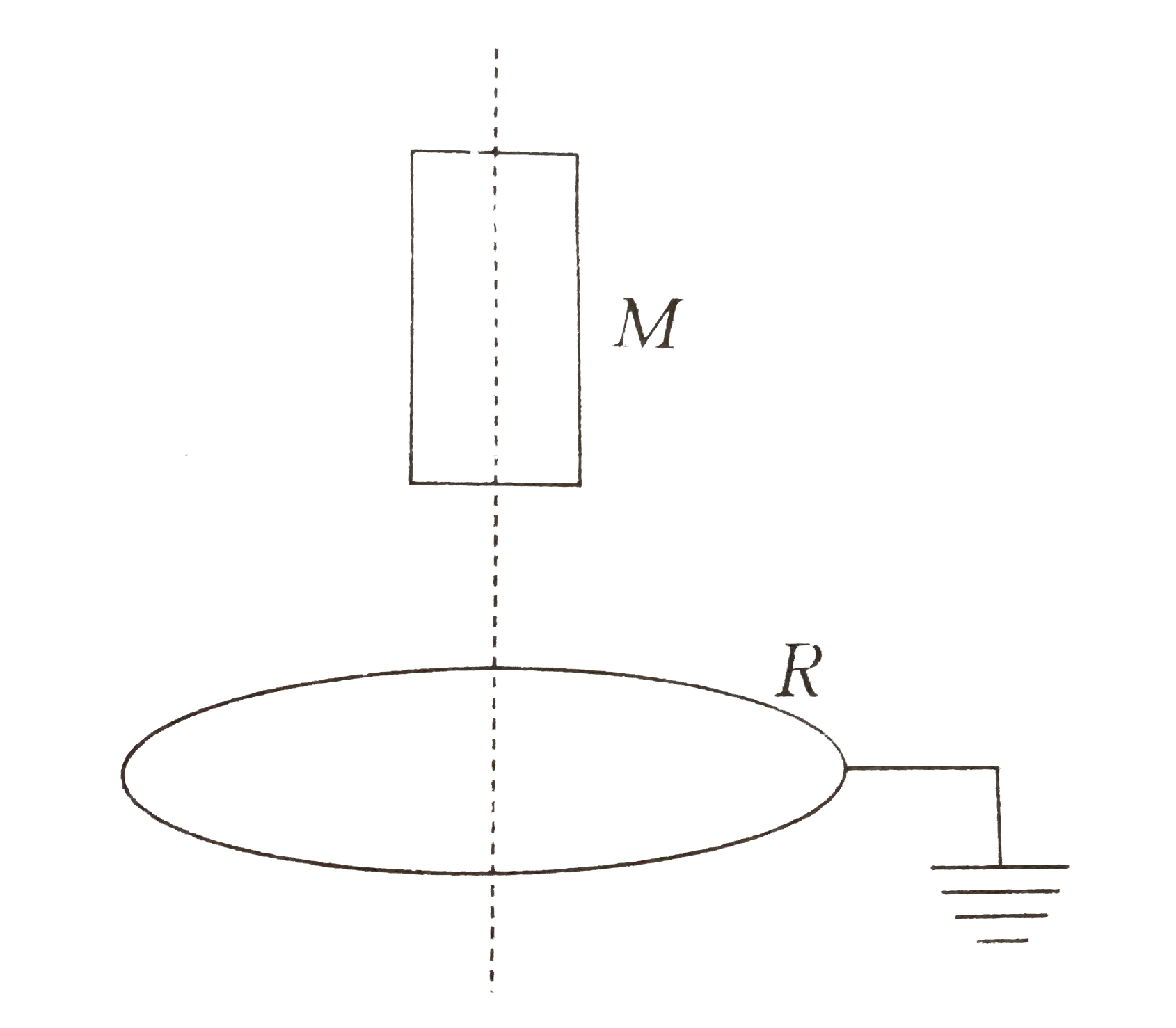
A small magnet M is allowed to fall through a fixed horizontal conducting ring R. Let g be the acceleration due to gravity. The acceleration of M, a will be

A

lt g when it is above R and moving towards R

B

gt g when it is above R and moving toward R

C

lt g when it is below R and moving away from R

D

gt g when it is below R and moving away from R

Text Solution

Verified by Experts

The correct Answer is:

A, C
Promotional Banner

Similar Questions

Explore conceptually related problems

A small magnet M is allowed to fall through a fixed horizontal conducting ring R . Let g be the acceleration due to gravity. The acceleration of M will be

A short magnet is allowed to fall from rest along the axis of a horizontal conducting ring. The distance fallen by the magnet in one second may be

Two masses m and m' are tied with a thread passing over a pulley, m' is on a frictionless horizontal surface and m is hanging freely. If acceleration due to gravity is g, the acceleration of m' in this arrangment will be :

In the fig. given masses m and m' are tied with a tread passing over a pulley, m' is on a frictionless horizontal surface. If acceleration due to gravity is g, the acceleration of m' in this arrangement will be:-

The acceleration due to gravity at a depth R//2 below the surface of the earth is

A point mass m, is placed at the surface of a hypothetical planet where acceleration due to gravity is g/2 , where g acceleration due to gravity at the poles the planet. The latitude of that position is [T is time period of planet rotation about its own axis and R is radius of planet]

If G is universal gravitational constant and g is acceleration due to gravity then the unit of the quantity (G)/(g) is

If G is universal gravitational constant and g is acceleration due to gravity then the unit of the quantity (G)/(g) is

A metallic ring with a small cut is held horizontally and a magnet is allowed to fall vertically through the ring then the acceleration of the magnet is :

A small steel ball of mass m and radius r is falling under gravity through a viscous liquid of coefficient of viscosity eta . If g is the value of acceleration due to gravity. Then the terminal velocity of the ball is proportional to (ignore buoyancy)
