Home
Class 12
PHYSICS
A coherent parallel beam of microwaves o...

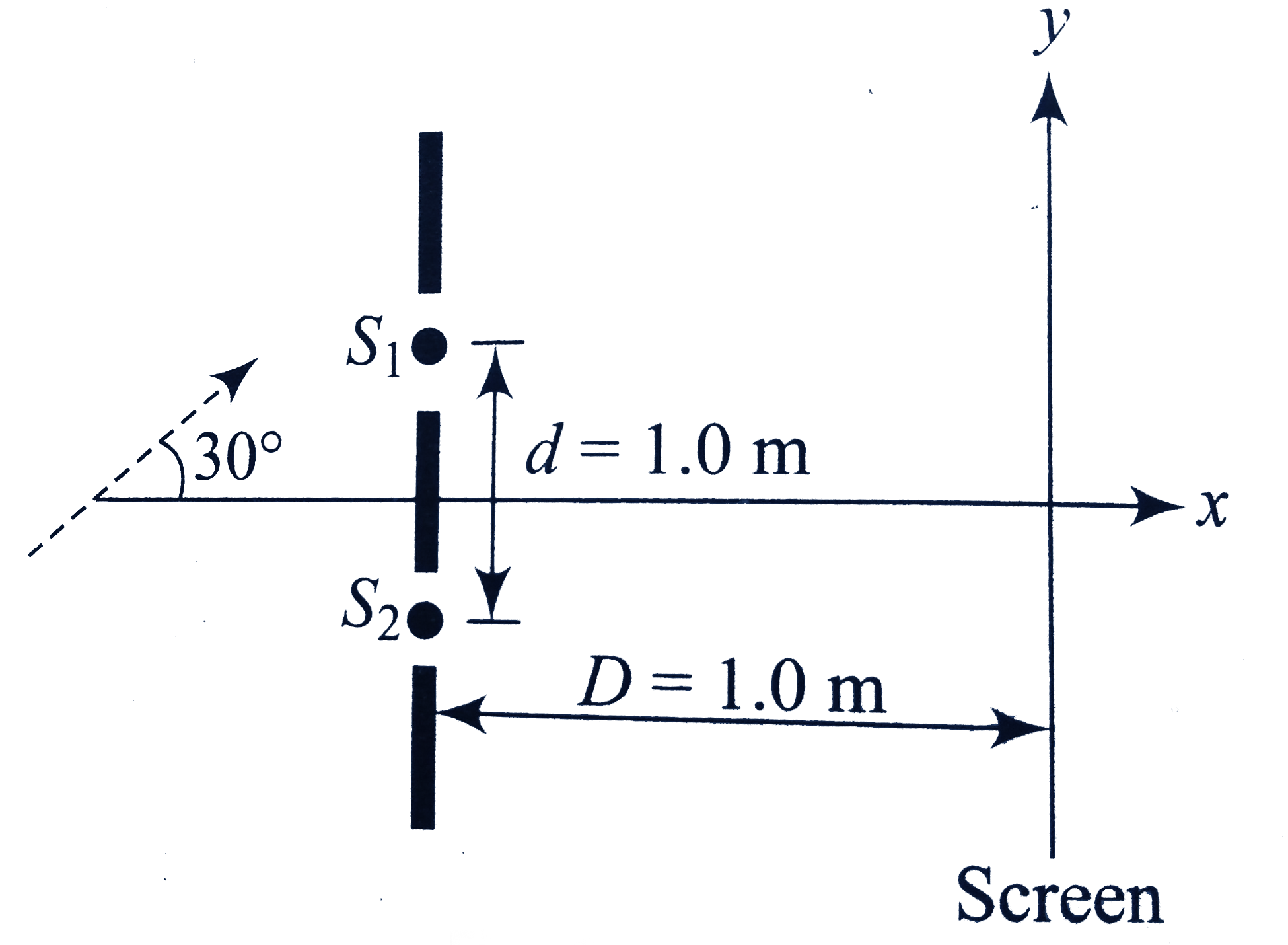
A coherent parallel beam of microwaves of wavelength `lambda = 0.5 mm` falls on aYoung's double- slit apparatus. The separation between the slits is 1.0 mm. The intensity of microwaves is measured on a screen placed parallel to the plane of the slits at a distance of 1.0 m from it as shown in figure

If the incient beam falls normally on the double-slit apparatus, find the order of the interference minima on the screen

Text Solution

Verified by Experts

(a) Given seperation between two slits = 2d 1.0mm, D=1.0m,
Path diffenrece = `2dsin theta`
For minima `2 d sintheta = (2n -1 ) lambda/2`
`therafore 1 xx 10^(-3) = ((2n-1)xx(0.5xx10^(-3)))/2` as `theta=90^@` for the highest possible order of minimum.
or `(2n-1) = (2xx10^(-3))/(0.5xx10^(-3)) implies n=2.5`
Thus, only two minima are possible on either side of central maxima. Thus total number of minima = 2+2 =4
For minima `y= pm ((2n-1)lambdaD)/(4d) = (2n-1)0.25`
`y_(1)=0.25m , y_(2)=0.75m` and `y_(4)= -0.75m`
(b) Initial path difference = `2d sin 30^@`
For the central maxima
`therefore y/D xx2d= 2d sin30^@`
`y=Dsin30^@=0.5m`
For first minima
`y/D xx2d -2dsin 30^@ = om lambda/2`
or `y= pm 0.25 + 0.5`
or `y_(1)0.75m ` and `y_(2) = 0.25 m`.
Promotional Banner

Similar Questions

Explore conceptually related problems

A coherent parallel beam of microwaves of wavelength lambda = 0.5 mm falls on aYoung's double- slit apparatus. The separation between the slits is 1.0 mm. The intensity of microwaves is measured on a screen placed parallel to the plane of the slits at a distance of 1.0 m from it as shown in Fig. 2.42. If the incident beam makes an angle or 30^(@) with the x-axis (as in the dotted arrow shown in the figure), find the y-coordinates of the first minima on either side of the central maximum.

In Young's double slit experiment, the separation between the slits is halved and the distance between the slits and the screen is doubled. The fringe width is

In Young's double-slit experiment, the separation between the slits is halved and the distance between the slits and the screen in doubled. The fringe width is

In Young's double slit experiment, white light is used. The seperation between the slits is kept 1 mm and intensity is observed on screen distance 2m from the plane of the slits. At a point on the screen directly opposite to the either slit which of the following wavelength is not present

In Young's double slit experiment, the sepcaration between the slits is halved and the distance between the slits and the screen is doubled. The fringe width is

In Young's double slit experiment, the sepcaration between the slits is halved and the distance between the slits and the screen is doubled. The fringe width is

Light of wavelength lambda = 5890 Å fall on a double-slit arrangement having separation d = 0.2 mm . A thin lens of focal length f = 1 m is placed near the slits. The linear separation of fringes on a screen placed in the focal plane of the lens is

In double slit experiment , the distance between two slits is 0.6mm and these are illuminated with light of wavelength 4800 Å . The angular width of dark fringe on the screen at a distance 120 cm from slits will be

In a Young's double slit experiment the separation between the slits is 0.10 mm, the wavelength of light used is 600 mm and the interference pattern is observed on a screen 1.0 m away. Find the separation between the successive bright fringes.

A source emitting light of wavelengths 480 nm and 600 nm is used in a double slit interference experiment. The separation between the slits is 0.25 mm and the interference is observed on a screen placed at 150 cm from the slits. Find the linear separation between the first maximum (next to the central maximum) corresponding to the two wavelengths.
